
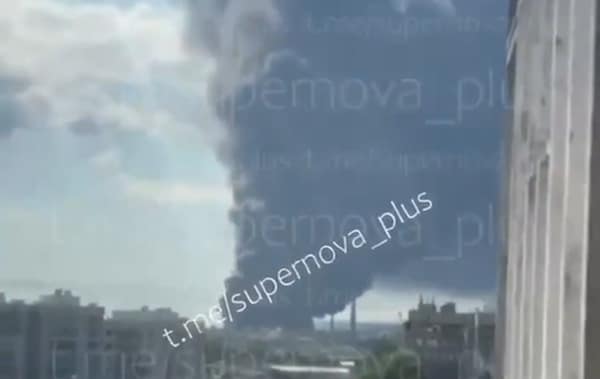
Kyiv’s escalating strikes on occupied Crimea mark a shift from battlefield confrontation to a broader campaign against the logistics, infrastructure and industrial systems sustaining Russia’s war effort.
Ukraine’s attacks on Russian assets in occupied Crimea are increasingly focused on weakening the economic and logistical foundations of Moscow’s military operations, according to Ukrainian officials.
Rather than pursuing only tactical gains on the front line, Kyiv appears to be targeting the infrastructure that enables Russia to maintain its war machine — from fuel supplies and transport links to air defence networks and military facilities.
Dmytro Pletenchuk, spokesperson for Ukraine’s Navy, said the campaign represents a multi-stage operation that has developed over several years.
He said: “We are witnessing another stage of a multi-step operation. We’re talking not about months, but years.
“First, naval logistics were destroyed, then the railway ferries, while at the same time air defences and facilities in the land corridor were being destroyed.”
The sequence, he said, began with efforts to disrupt Russian naval logistics, followed by attacks on railway connections, air defences and land-based supply infrastructure.
The strategy reflects a broader evolution in modern warfare: the ability to sustain military operations is becoming as important as controlling territory.
🇺🇦🇷🇺⚡️Power outages reported across Crimea as Ukrainian strikes hit multiple targets. Multiple air defense systems were destroyed as well with panic reported on the Kerch Bridge pic.twitter.com/x8jOGrjPuN
— War Flash (@WarFlash_2630) June 28, 2026
Recent strikes have focused heavily on Crimea, a peninsula that serves as a key hub for Russian military activity in southern Ukraine.
Ukrainian attacks on June 20 reportedly targeted Russian air defence systems, fuel storage facilities and ferry infrastructure at the Kerch crossing — a critical logistical route connecting Crimea with Russia.
A larger drone operation days later struck dozens of military and infrastructure targets, including energy facilities, radar stations and an oil depot in Dzhankoi.
The response from Russian-installed authorities was significant, with a state of emergency declared across Crimea and Sevastopol.
For Moscow, the challenge is not simply repairing damaged facilities. It is managing the growing cost of protecting a vast network of strategic assets.
Russia’s air defence resources are finite. Every system deployed to protect one facility leaves another potentially exposed.
The Institute for the Study of War has assessed that Ukrainian strikes against bridges and supply routes are complicating Russia’s ability to move equipment and prepare future offensive operations.
The economic implications are increasingly important.
After a nightly massive attack of shock UAVs on the refinery in Slavyansk in the Kuban, half of the Krasnodar Territory was covered with smoke. It doesn't make sense to put it all out. “Tigers” at the air defense pissed off a plant that shipped fuel to the occupied Crimea.… pic.twitter.com/4wSysLFZDL
— big ben (@alternative_war) June 28, 2026
Military campaigns depend on reliable logistics: fuel distribution, transport networks, industrial output and secure supply chains. Disrupting those systems can create pressure far beyond the immediate impact of individual strikes.
Crimea has long been central to Russia’s military posture in the Black Sea region. Since Moscow’s annexation of the peninsula in 2014, it has been transformed into a major base for naval operations, missile systems and regional logistics.
Ukraine’s current strategy is aimed at challenging that role.
The objective is not necessarily to achieve a single decisive strike, but to create cumulative pressure that forces Russia to spend more resources defending territory it considers secure.
President Volodymyr Zelenskyy has said Ukraine’s Crimea operation has been carefully planned and that additional Western capabilities could accelerate pressure on Moscow.
The Kremlin continues to insist Crimea is permanently under Russian control.
But the growing frequency of attacks suggests the peninsula’s strategic value is increasingly being tested — not only as a military asset, but as a symbol of Russia’s ability to sustain its wider war effort.
The battle for Crimea is becoming a contest of endurance: whether Ukraine can continue degrading the systems behind Russia’s offensive faster than Moscow can rebuild and protect them.


Leave a Comment