
The first time Matt Haycox sat across a table from an Insolvency Practitioner, he was the one in trouble. Not the adviser. Not the consultant. The director. The man whose name was on the paperwork, whose home was on the line, whose phone wouldn’t stop ringing.
He remembers the conversation with a clarity that has shaped everything he has built since.
“I walked in thinking this person was on my side,” he says. “I walked out understanding that nobody in that room was on my side except me. And I didn’t even know what questions to ask.”
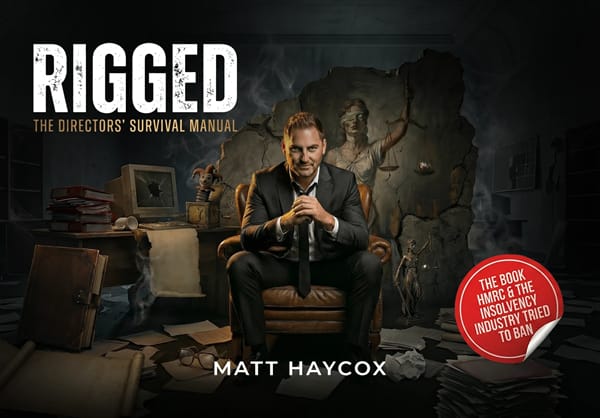
Two decades and one full rebuild later, Haycox has written the book he wishes had existed that afternoon. RIGGED: The Directors’ Survival Manual is 200+ pages of plain-English explanation of an industry that, in his telling, has spent decades profiting from the silence of the people it claims to serve. Published through his platform Insolvency.World, the book has become one of the most divisive pieces of business writing to land in the UK in years — celebrated by directors who have read it, quietly resented by parts of the profession it dissects.
The long road to the book
Haycox is not, by background, an author. He is an entrepreneur, and an unusually prolific one. Over twenty-five years in business, he has been involved in more than a hundred companies, raised in excess of £250 million in capital, and built a lending operation that deployed close to £1 billion to small and medium-sized businesses across the UK. The CV reads like that of a man for whom things have always worked out.
The reality is more complicated. Somewhere in the middle of that twenty-five-year arc, things stopped working out. A business collapsed. Personal guarantees came due. A man who had spent years on one side of the lending table — the side that approved or declined other people’s survival — found himself on the other side of it. He has been candid about the experience in the years since, less because he enjoys revisiting it than because he has come to see it as the only credential that matters for what he is now doing.
“I’m not a solicitor. I’m not an Insolvency Practitioner. I’m not pretending to be,” he says. “What I am is somebody who sat in the chair. Who got the calls. Who lost the lot. And who has spent the years since figuring out how the system actually works, as opposed to how the system tells you it works.”
He has rebuilt — quickly, and on multiple fronts. He runs businesses again. He invests. He hosts a podcast. He is also the founder of Dominate Online, a marketing agency focused on helping businesses increase visibility and generate growth online. He has built Insolvency.World into a resource platform for directors who find themselves where he once was, with consultation calls, written guides, and now the book.
Why the book is controversial
The controversy around RIGGED is not really about its tone, although the tone is unmistakably combative. It is about its central claim, which is that the British insolvency industry operates on a set of financial incentives that systematically disadvantage the directors it is meant to advise.
Insolvency Practitioners, Haycox argues, earn substantially more from liquidating a company than from rescuing it. Accountants frequently maintain referral relationships with Insolvency Practitioners, meaning a director walking into their accountant’s office in distress may, without knowing it, be walking into the front end of a referral chain. The full menu of options — Company Voluntary Arrangements, administration, pre-pack sales, informal arrangements with creditors — is, in his account, rarely presented in its entirety, because the people doing the presenting do not always benefit from a director understanding their choices in full.
“Nobody tells you this stuff,” he says, “because nobody benefits from you knowing it. Except you.”
It is the kind of statement that has, predictably, generated friction. Haycox says he has had warnings — calls from people in the industry suggesting he should think carefully about what he was publishing, conversations that hovered somewhere between collegial and not-quite-veiled. The marketing line that has attached itself to the book — that this is the volume HMRC and the insolvency industry tried to ban — is, he readily admits, more theatrical than literal. No injunction has been filed. No legal challenge has materialised. But the discomfort the book has created is real, and he is not interested in pretending otherwise.
“If you don’t like the line, write a better book,” he says. “I’m not making the situation provocative. The situation is provocative. I’m just describing it.”
Not anti-industry. Anti-bullshit.
What separates RIGGED from a simple polemic is that Haycox is careful about where he aims. He is not arguing that all Insolvency Practitioners are villains. He is not arguing that liquidation is always the wrong answer. He is not, despite the framing, suggesting that the entire profession should be abolished.
“I’m not anti-Insolvency Practitioner. I’m anti-bullshit,” he says. “There are good Insolvency Practitioners out there. The problem isn’t the individuals. The problem is a system where the default outcome benefits the adviser more than the advised, and where nobody is going to fix it for you because nobody in the system is incentivised to.”
The book’s most useful contribution, on a straightforward reading, is not the polemic at all. It is the practical content. Significant chapters walk directors through the realistic menu of options available to a company in financial difficulty, and through the personal liability landmines — directors’ loan accounts that quietly become personal debts, personal guarantees that surface years after they were signed, wrongful trading exposure that crystallises at the moment a director should reasonably have known their company was insolvent.
These are, in Haycox’s experience, the conversations that do not happen until it is too late for the conversation to matter.
“By the time most directors find out what a personal guarantee actually means,” he says, “the bank has already called it in. By the time they understand their directors’ loan account, the Insolvency Practitioner is already asking for the money back. That’s not bad luck. That’s a system that benefits from your ignorance.”

Matt Haycox
A book arriving at a moment
The timing of RIGGED is not coincidental. UK company insolvencies have been running at or near 30-year highs. HMRC, after a comparatively passive period during the pandemic, has returned to enforcement with a posture that many advisers privately describe as the most aggressive they can remember, with winding-up petitions issued as a first resort more often than a last. Hundreds of thousands of Bounce Back Loans, issued at speed during the Covid emergency, are now in distress or default, and a generation of directors who took them in good faith are discovering that the line between company debt and personal liability is considerably less firm than they had assumed.
It is into this environment that the book lands. And it is this environment that has, more than anything else, driven its reception. The directors reading it are not, for the most part, abstract policy observers. They are people sitting at kitchen tables with letters in front of them, trying to work out what their actual options are before they sign something they cannot unsign.
The platform behind the book
Insolvency.World is the platform Haycox has built around the work. It is not, he is careful to say, a replacement for proper legal or restructuring advice. It is a second opinion. A place where a director can find out, before they walk into the first formal meeting of their lives, what the formal meeting is actually about. The consultation calls he offers through the site are framed in exactly those terms.
“Get the second opinion,” he says. “Get it before you sign anything. Get it from somebody whose fee doesn’t depend on which option you choose. That’s the whole point. That’s the whole book.”
What comes next
Whether Haycox’s work ultimately changes anything structural about the UK insolvency industry is a question for a longer timeframe than this one. The industry is large, well-organised, and not given to volunteering reforms that reduce its own revenue. Regulatory change, if it comes, will come at its own pace.
But the book exists now. The platform exists now. And the information that, until recently, lived inside the heads of professional advisers and behind the doors of expensive consultations is, for the cost of a paperback, available to the directors who need it.
For a man who once sat across a table not knowing what questions to ask, that may be the only outcome that ever mattered.
“The most expensive conversation of your life,” Haycox writes in the closing pages of RIGGED, “is the one where you don’t know what questions to ask.”
The book is his answer to that conversation. Whether the industry likes it or not.


Leave a Comment