
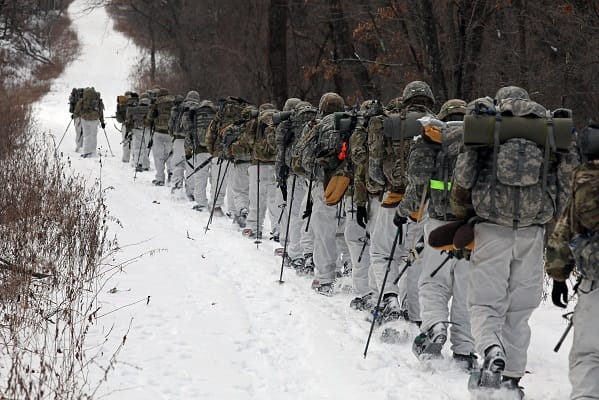
British troops could train alongside Ukrainian forces on Ukrainian soil after the war with Russia ends, under plans for a multinational European military deployment designed to deter Vladimir Putin from launching another invasion.
The proposal would mark a significant expansion of Britain’s military role in Ukraine and is likely to provoke fierce opposition from the Kremlin, which has repeatedly warned that Western troops stationed in the country would be considered “legitimate targets”.
The plan forms part of the Coalition of the Willing’s proposed Multinational Force Ukraine (MNF-U), a European-led initiative intended to provide security assurances and help rebuild Ukraine’s armed forces once hostilities have stopped.
Lieutenant General Tom Bateman, the British commander of the force’s military arm, said its principal task would be to help regenerate Kyiv’s military capability, drawing on European resources while also learning from Ukraine’s extensive battlefield experience.
Read more related news:
‘Depending on someone’s mood’: Ukraine’s defence chief delivers damning warning over America’s support
Putin has ‘used the ceasefire to rearm’ exploiting humanitarian truce to reinforce troops
Burnham faces devastating warning from Lord Dannatt over Britain’s defences as he’s ‘squandering 365 days’
Russian spy ship shadows NATO exercise as Royal Navy scrambles helicopters to monitor its movements
“The MNF-U will provide logistics, equipment and training expertise to help accelerate the regeneration and reconstitution of Ukraine’s armed forces,” he said. “MNF-U personnel will also train alongside the armed forces of Ukraine to strengthen interoperability and enhance operational capability.”
The prospect of British personnel training inside Ukraine would carry considerable political and military significance. Moscow has consistently opposed the deployment of Western forces, even under a post-ceasefire arrangement, arguing that their presence would constitute direct involvement in the conflict.
But Western officials argue that the relationship would benefit both sides. Ukrainian forces have accumulated years of experience fighting a technologically sophisticated opponent, including in drone warfare, electronic disruption and modern battlefield operations.
One Western official described the training as having a “reciprocal benefit”, saying: “The Ukrainians have an enormous amount of experience now and are fighting a very modern version of warfare that we need to continue to benefit from as the Western nations. Therefore, there’s an opportunity for us to draw from them and understand it.”
The proposals will be put to a major test in Poland from November 9, when 2,800 military personnel from 11 countries begin Exercise Koalicja. Led jointly by Britain and France, the two-week exercise will rehearse how the multinational force would help secure a postwar settlement and support Ukraine if a peace agreement is reached.
Around 300 British troops will participate, including soldiers from the Army’s 7 Brigade, known as the Desert Rats, who will practise the logistical movements needed to sustain a multinational deployment.
The Royal Air Force will also contribute Typhoon fighter jets and a Voyager tanker, flying sorties designed to simulate reassurance operations for commercial aviation when Ukrainian airspace eventually reopens. Turkey will establish the force’s maritime element in Istanbul, where personnel will rehearse plans for clearing mines from the Black Sea to enable commercial shipping to return safely to Ukrainian ports.
Belgium, Estonia, Germany, Lithuania, the Netherlands, Poland, Spain, Sweden and Turkey are also taking part.
The exercise comes despite little visible progress towards ending the war, which is approaching its sixth year since Russia’s full-scale invasion. A fresh round of US-led negotiations is due to begin next week in Abu Dhabi, involving representatives from Washington, Kyiv and Moscow. Efforts by the Trump administration to secure an agreement have lost momentum since the outbreak of the Middle East conflict.
General Bateman insisted the MNF-U must nevertheless be prepared to act if a settlement emerges. He stressed that it would not be a conventional peacekeeping force or monitor a ceasefire, and was “not designed” to conduct offensive operations.
“Its purpose is to provide reassurance and support the regeneration of Ukraine’s armed forces, strengthening their ability to deter and, if necessary, defend against future Russian aggression,” he said.
Deployment would take place only at the invitation of the Ukrainian government, following a peace deal and once the “necessary political and military conditions” had been met.
Defence Secretary Wes Streeting said Britain was “stepping up” preparations for a potential end to the fighting. “This isn’t a hypothetical plan; it’s a real force, ready to help Ukraine once the fighting stops,” he said.
The initiative is being developed outside Nato’s formal command structure, despite all participating countries being alliance members. The absence of the US is particularly significant, reflecting the Trump administration’s pressure on European allies to assume greater responsibility for the continent’s security.
A Western official said the force was “not dependent upon US systems”, although it remains unclear whether Washington will provide intelligence support.
The MNF-U headquarters are expected to move from Paris to London by the end of the year. Its success, however, will depend on a peace agreement that remains elusive — and on whether European governments are prepared to put personnel on the ground in a country that Russia may continue to regard as a legitimate target.


Leave a Comment