
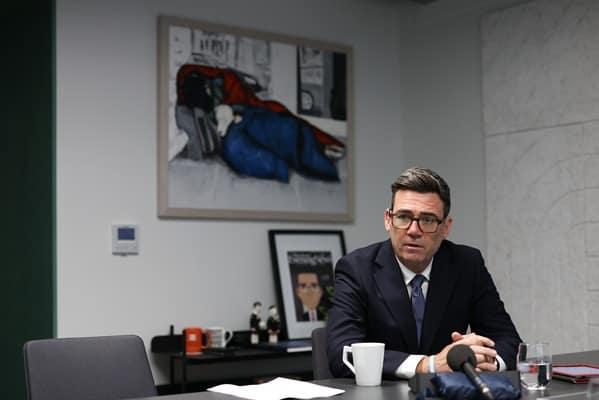
A Manchester mosque visited and praised by Prime Minister Andy Burnham earlier this year has come under political scrutiny after holding the funeral of Munir Farooqi, a convicted terrorist and former Taliban fighter who was serving four life sentences.
Manchester Central Mosque hosted a janazah, or Muslim funeral service, for Farooqi on September 30, after he died in prison at the end of September aged 69. More than 100 people are reported to have attended, including members of his family.
The case has revived questions over the boundaries between religious institutions, community engagement and the Government’s approach to Islamist extremism.
Farooqi was sentenced in 2011 after being convicted of preparing acts of terrorism, soliciting murder and disseminating terrorist publications. He had travelled to Afghanistan after the September 11 attacks and fought alongside the Taliban before returning to Manchester, where prosecutors said he established a recruitment operation targeting vulnerable men.
The court heard that recruits were encouraged to “fight, kill and die” in Afghanistan. Farooqi was described by the sentencing judge, Mr Justice Richard Henriques, as “a very dangerous man, an extremist, a fundamentalist with a determination to fight abroad”.
His funeral at the mosque came months after Burnham, then mayor of Greater Manchester, attended an Iftar at the same venue during Ramadan.
Labour MPs Debbie Abrahams and Afzal Khan were also present, alongside Greater Manchester mayor Bev Craig and Labour candidate Angeliki Stogia.
During the visit, Burnham praised the mosque’s “togetherness” and said: “We’re not about allowing any room for the politics of division in Greater Manchester and creating a climate where that can advance.”
The February visit followed a security incident at the mosque, after two men entered the building allegedly carrying weapons. Greater Manchester authorities subsequently said there had been no direct threats or violence and announced increased police presence around places of worship.
Burnham said at the time: “Everybody in our city region, whoever they are, whatever faith they follow, should be free at all times to practice that faith and to worship in their communities.
“We will never accept a city region where people have any fear of being at their place of worship, and that’s why we’re working with Greater Manchester Police to strengthen security at places of worship as much as we possibly can.”
The revelation that the mosque subsequently hosted Farooqi’s funeral has prompted criticism from Chris Philp, the Conservative shadow home secretary, who called for the prime minister to explain his connection to the venue.
“The Prime Minister must apologise if it is true he attended a Manchester mosque that disgracefully held a funeral for a convicted terrorist and ex-Taliban fighter,” Philp said.
“Islamist extremism is the biggest threat facing our society, and we must do everything in our power to combat it rather than pander to those proliferating it.
“It is deeply concerning the Labour Government does not have the backbone to confront this reality.”
The mosque has rejected any suggestion that conducting the funeral amounted to an endorsement of Farooqi’s actions.
“As an Islamic institution, we undertake the responsibility of performing funerals for all Muslims,” a spokesman said.
“Our core belief is that every person who has died deserves a respectful and dignified funeral. It is not our position, nor our role, to give judgments on a person’s actions, especially those who are deceased.
“As Muslims, we leave all judgments to God.”
The mosque added that its role was to “serve the community and provide the necessary religious rites with dignity”, while saying the family had requested “peace and privacy”.
The controversy therefore centres on a difficult distinction for politicians: whether engagement with a religious institution should be judged independently of the actions of individuals who later use its facilities, and how far public figures should scrutinise the institutions with which they build relationships.
For Burnham, the episode comes at a particularly sensitive moment as his government faces renewed political pressure over the threat posed by Islamist extremism.
Farooqi’s conviction is not in dispute. Nor is the mosque’s position that it performs funerals as part of its religious responsibilities.
The political question is whether that distinction is sufficient to prevent a funeral for one of Britain’s most notorious jihadist recruiters from becoming a test of the Government’s approach to extremism — and of the institutions it chooses to publicly embrace.


Leave a Comment