
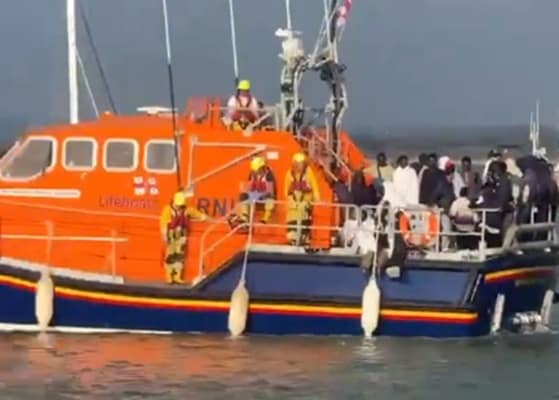
France has ruled out allowing its police to wade into shallow Channel waters to stop migrant boats launching for Britain, exposing a fresh fault line in the UK-France agreement as crossings surge to their highest levels of the year.
Laurent Nuñez, France’s interior minister, told a parliamentary inquiry that French police and gendarmes do not intervene once migrants have entered the water, except where an immediate rescue is required.
His comments underline the limits of the bilateral arrangements between London and Paris, despite the British government providing hundreds of millions of pounds to support French enforcement operations along the northern French coast.
“On the boundary between what is at sea and what is on land, I would say that there is no intervention by the police or the gendarmerie once people are in the water,” Nuñez said.
The French minister also rejected reports of officers damaging boats in shallow water to prevent them from departing.
“Regarding the actions you mention, which allegedly involve damaging boats to prevent them from setting sail again, I repeat that our priority is saving human lives. I am not aware of such practices, which are unacceptable,” he said.
The remarks come at a politically sensitive moment for the UK-France migration partnership.
Official Home Office figures show that 781 people arrived in Britain by small boat on September 23, the highest single-day total recorded so far in 2026. A further 150 people arrived on September 21 and 154 on September 22.
Despite the recent surge, overall arrivals remain more than 40 per cent lower than at the same point last year, according to the UK government. More than 1,400 people have so far been returned to France under the current UK-France agreement.
Nuñez told the French parliamentary commission that intervention is permitted within two separate frameworks.
The first allows French authorities to prevent migrants from reaching the water while they remain on land.
The second is a newer maritime operation targeting so-called taxi boats operated by smuggling networks. Nuñez said the maritime doctrine had resulted in around ten interventions since its introduction several months ago.
“The doctrine for intervention at sea is a different matter; it is an operation carried out under the authority of the maritime prefect under extremely strictly defined conditions,” he said.
Outside those circumstances, French police and gendarmerie forces do not intervene once migrants are in the water, with rescue remaining an exception.
The distinction is significant for Britain’s border strategy.
The UK-France agreement signed in April committed the two countries to increased patrols, intelligence operations and resources in northern France. The government said French units prevented 185 potential crossing events during the first three months of the new deal, including through stopping launches, seizing equipment and arresting suspected smugglers.
But the French position makes clear that Britain’s preferred approach cannot simply be imposed on French territory or territorial waters.
Chris Philp, the Conservative shadow home secretary, accused Paris of failing to go far enough.
“This confirms what a French gendarme admitted to me on a beach a few weeks ago French land forces will stand by and do nothing while illegal immigrants embark in knee-deep water,” he said.
“Some of them later drown so not intervening is actually causing people to die” he added.
“I have stood next to a boat launching in shallow water and they could easily be safely stopped, as the Belgians do.”
Philp also accused the French government of failing to honour commitments he said had been made to Britain.
“The French Government is openly defying Shabana Mahmood. President Macron promised back in July 2025 he would change the French law to allow intervention in shallow water but nothing has changed,” he said.
The dispute comes as the cost and effectiveness of the UK-France border partnership face increasing scrutiny.
The UK has agreed to provide France with £662mn between 2026/27 and 2028/29, including £501mn for existing controls in northern France and £161mn for new tactics.
At the same time, the operational environment is becoming more difficult. French authorities recently monitored a migrant boat carrying about 60 people for more than 33 hours after it left the Normandy coast, describing the vessel as unsuitable for the crossing and its occupants as weakened by their prolonged time at sea.
For London, the central challenge is that preventing Channel crossings depends heavily on what French authorities are prepared and legally able to do before boats reach open water.
For Paris, Nuñez’s testimony reinforces a different principle: France will determine how its police operate on French territory, while maritime interventions remain subject to a separate French command structure.
The result is an increasingly awkward division of responsibility.
Britain wants departures stopped before migrants reach the Channel.
France says its forces can intervene on land, can target smuggling operations at sea under tightly defined conditions, and can rescue people in danger — but will not simply wade into the water to prevent a migrant boat from launching.
With crossings continuing despite the new enforcement agreement, that boundary is likely to remain one of the most contentious issues in the next phase of UK-France migration policy.


Leave a Comment