
For much of the previous week, perhaps longer, it had been relatively quiet where I live in Dnipro.
I had recently written about the dangers of complacency when you live in a country at war. Then, on Saturday morning, I realised I had somewhat fallen for it myself.
I posted on X that the quietness was making me suspicious, my “Spidey sense” was tingling.
I didn’t have to wait long.
Russian jet-powered drones began flying low across Dnipro, one after another, passing close to our home. I stood on the steps leading into our bunker, around eight feet underground, listening to their unmistakable engines crossing a densely populated city in broad daylight.
I have been around war in some form for more than 15 years, serving in two militaries and experiencing Northern Ireland, Bosnia, Syria and now Ukraine.
Read more related news:
Europe already in a form of ‘World War III’ as Burnham faces pressure to strengthen defences
Europe braces for war as hospitals prepare for 1,000 wounded NATO troops a day
Royal Navy chief delivers damning warning to Burnham over Britain’s defences
‘Eurob****ds understand only brute force’ as Kremlin warns of ‘direct military deterrence’
European spy chiefs warn Russia could test NATO’s Article 5 within ‘months not years’
But this is different.
I’m no longer on the frontline. I’m at home, yet sometimes it feels like being back on the zero line — except now your family is standing beside you.
The attacks continued throughout Saturday afternoon, when people were outside, shops were open and families were walking along Dnipro’s riverfront.
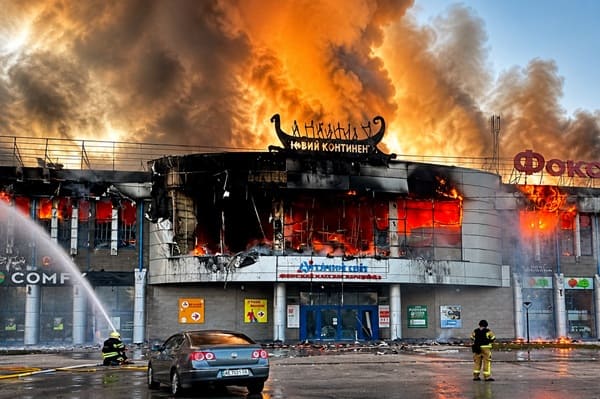
Then the Novyi Kontynent shopping centre was hit.
Remarkably, only five people were injured.
The shopping centre burned, while nearby apartment blocks were damaged and windows blown out. Ukrainian police described the mall as a civilian object and said investigators were documenting the attack as a suspected war crime.
I returned the following morning.
The first thing that struck me wasn’t what I could see, but what I could smell: old barbecue mixed with stale water.
Everything was black, wet and burned. People were already picking through the wreckage, trying to salvage stock and whatever else remained.
Directly opposite is a park and river walk popular with families and children.
This was a Saturday afternoon.
How it did not become a mass-casualty incident was probably down to extraordinary luck.
The scale of the danger facing Ukrainian civilians is becoming increasingly difficult to ignore.
UN monitors recorded 2,222 civilians killed and 13,058 injured in Ukraine during the first eight months of 2026, already exceeding the total recorded for all of 2025.
Long-range missiles and drones were the leading cause of civilian casualties in August, with most victims hit in urban areas far from the frontline.
It’s getting worse, not better.
But overnight, the direction of travel changed.
Ukraine launched what Moscow Mayor Sergei Sobyanin called the largest drone attack on the Russian capital since the full-scale invasion began.
Russian authorities claimed more than 1,600 drones had been intercepted since September 19, including 450 approaching Moscow. Russia’s Defence Ministry claimed 1,110 interceptions overnight across Russia, occupied Crimea and the Black Sea.
Those are Russian figures and cannot be independently verified.
But there is an undeniable irony in the scale of the claims.
This is the same war Moscow continues to insist is going according to plan.
The “three-day Special Military Operation” has now reached the slightly awkward stage where, more than four years later, Moscow is defending itself from what its mayor described as the largest Ukrainian drone attack of the war.
Somewhere, the original PowerPoint presentation has gone badly wrong.
President Volodymyr Zelensky confirmed that the Ukrainian operation involved ten long-range systems: FP-1, RZ-100, MICH-2000, Palianytsia, Vendetta, Liutyi, Bars, Flamingo, Sichen and Pelican.
The SBU, Unmanned Systems Forces, Special Operations Forces, Defence Intelligence and Foreign Intelligence Service were involved.
The Moscow Oil Refinery at Kapotnya was hit, along with a logistics facility, while Moscow’s airports suffered major disruption. The operation also coincided with the final day of Russia’s parliamentary elections.
For Ukrainians, the sound of drones and explosions has been part of everyday life for more than four years.
So you can imagine the symbolism of watching Moscow’s skyline fill with smoke.
But this is more than symbolism.
Russia has spent years trying to make Ukrainian cities increasingly difficult to live in. Its missile and drone campaigns have repeatedly targeted energy infrastructure, industrial facilities and cities far from the battlefield.
Ukraine argues that its own long-range strikes are aimed instead at the military, energy and logistical infrastructure sustaining Russia’s invasion.
Zelensky described the Moscow targets as oil and logistics facilities supporting the Russian war machine.
The distinction matters.
A war in which both sides possess long-range strike capabilities inevitably creates risks for civilians far from the front.
But after more than four years of Russia bringing the war to Ukrainian cities, the geography of the conflict is changing.
Moscow has received another reminder that distance from Ukraine no longer guarantees distance from the war.
For those of us living here, there is little satisfaction in that.
The sound of a Russian drone passing over your home does not become less frightening because a Ukrainian drone is flying towards Moscow.
But there is a strategic reality that cannot be ignored.
Russia began this war with the expectation that Ukraine could be overwhelmed quickly and that the fighting could be kept largely within Ukrainian territory.
Four years later, Ukraine possesses long-range systems capable of reaching deep inside Russia and disrupting the infrastructure that sustains Moscow’s war effort.
After years of Russian attacks on Ukrainian cities, the consequences of the war are increasingly reaching the country that started it.
And one simple fact remains:
Russia can stop this war tomorrow, if it wanted to.


Leave a Comment