
Ukraine is fighting a different kind of war — one where the most dangerous weapons may not be tanks roaring across muddy fields, but silent drones, invisible electronic attacks and lines of computer code.
As Russia pours thousands of soldiers and billions of pounds into its invasion, Kyiv is betting on a new battlefield: technology.
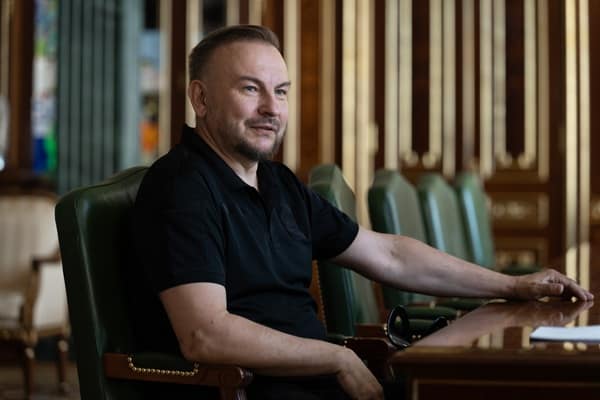
And at the centre of that effort is one of Ukraine’s most influential defence innovators, Serhii “Flash” Beskrestnov, who has rejected a return to the Defence Ministry after the departure of his political ally Mykhailo Fedorov — but has taken a role even closer to the centre of power as President Volodymyr Zelensky’s adviser on defence technologies.
His message is clear: Ukraine cannot afford to fight Russia on Moscow’s terms.
It must fight smarter.
The man helping Ukraine wage a digital war
Beskrestnov became known as one of the key figures behind Ukraine’s push to transform battlefield technology from a supporting tool into a decisive weapon.
While Russia has relied heavily on its advantages in manpower, artillery and industrial output, Ukraine has attempted to compensate through innovation.
The result has been a battlefield unlike any previous conflict.
Drones now hunt tanks. Electronic warfare can blind entire units. Artificial intelligence is changing how targets are identified and attacked.
The war is increasingly becoming a contest between two different philosophies.
Russia believes it can overwhelm Ukraine through mass.
Kyiv believes it can survive through speed.
Putin’s army meets Ukraine’s start-up battlefield
When Vladimir Putin launched his invasion, the Kremlin expected a conventional victory.
The assumption was that Russia’s larger military, huge weapons stockpiles and defence industry would eventually crush Ukrainian resistance.
But the war has evolved into something Moscow did not fully anticipate.
A Ukrainian drone costing a fraction of a missile can destroy equipment worth millions.
Small teams of engineers can create battlefield solutions in weeks.
Civilian technology companies have become part of the national defence effort.
Ukraine has effectively turned its war effort into a giant laboratory — where ideas are tested under the harshest conditions imaginable.
The battle Russia cannot simply outspend
The Kremlin’s greatest advantage has always been scale.
Russia has more soldiers, more territory and a larger industrial base.
But Ukraine is targeting a different weakness: Russia’s ability to adapt.
Every new Russian system creates a new challenge.
Every Ukrainian breakthrough forces Moscow to spend money responding.
The economics are brutal.
A relatively cheap drone can force Russia to deploy expensive air defences.
A software update can neutralise years of investment in military hardware.
The battlefield is becoming a financial war as much as a military one.
The invisible war behind the explosions
While artillery battles dominate headlines, another conflict is taking place almost silently.
Electronic warfare has become one of the defining features of the war.
Both sides are fighting to jam communications, disrupt navigation systems and prevent enemy drones from reaching their targets.
The advantage can change within days.
A system that works today may become useless tomorrow.
That constant cycle of adaptation has turned the conflict into a technological arms race.
Russia is adapting — but Ukraine wants to stay ahead
The Kremlin has not ignored the lessons of the battlefield.
Russia has expanded its own drone production, improved electronic warfare capabilities and adjusted tactics after early failures.
For Ukraine, the challenge is staying ahead.
Innovation is not a one-time advantage.
It is a race that never stops.
That is why Beskrestnov’s new role matters.
His move to the presidential team shows Kyiv sees defence technology as a national priority — not simply a military department issue.
The future of war is being written in Ukraine
The conflict has already changed military thinking around the world.
The image of war as tanks crossing open fields is being replaced by a more complex reality: networks, sensors, autonomous systems and artificial intelligence shaping decisions in real time.
Ukraine’s gamble is that a smaller country can defeat a larger aggressor by becoming faster, smarter and more innovative.
The stakes could hardly be higher.
If Kyiv succeeds, it will prove that technological agility can overcome traditional military power.
If it fails, Russia’s vast resources may eventually overwhelm Ukraine’s advantages.
But one thing is already clear.
The next generation of warfare is not being designed in a quiet defence laboratory.
It is being tested every day under fire — in Ukraine.
And Putin’s generals are discovering that the most dangerous weapon on the battlefield may not be a missile.
It may be an idea.


Leave a Comment