
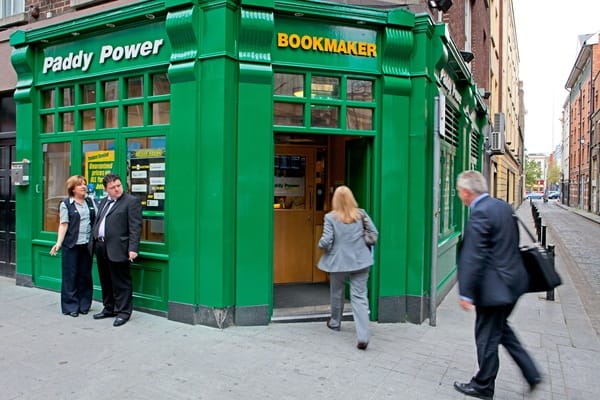
Flutter Entertainment, the owner of Paddy Power, is planning to cut around 1,400 jobs across the UK and Ireland as a sharp increase in gambling taxes forces one of the industry’s biggest operators into a sweeping cost-cutting drive.
The proposed redundancies will affect staff in Leeds and Dublin, as well as UK and Irish employees based at the group’s offices in Porto, Portugal, and Cluj-Napoca, Romania.
Flutter employs about 9,000 people across its UK and Irish operations, meaning the cuts could affect roughly 15 per cent of its workforce in the two markets.
The restructuring marks a significant escalation in the battle between the gambling industry and the Government over taxation, with operators warning that higher duties threaten jobs, investment and the competitiveness of regulated betting businesses.
Flutter said the overhaul was necessary to mitigate the impact of a “significant increase” in UK gambling taxes announced in last year’s autumn Budget. Kevin Harrington, chief executive of Flutter’s UK and Ireland division, said the company could not absorb the increase without reducing its fixed costs.
“The material increase in betting and gaming duties announced in the UK budget last year has fundamentally changed the economic model of the regulated betting and gaming industry in the UK while helping to fuel the unlicensed, unregulated market,” he said.
“As we warned a year ago, we cannot fully absorb a rise of this magnitude without reducing our fixed cost base and therefore must restructure our business so that we can best position ourselves for the future.”
The proposed cuts are expected to cost Flutter between $80 million and $90 million, equivalent to approximately £60 million to £67.5 million, as the group reorganises its operations to protect profitability.
At the centre of the dispute is a sharp increase in the tax on online gambling. Remote gaming duty, which applies to online casino games and slots, rose from 21 per cent to 40 per cent earlier this year. A separate increase in general betting duty for online bets, from 15 per cent to 25 per cent, is due to take effect next April.
The measures represent a substantial increase in the tax burden on operators at a time when competition for customers remains intense. Flutter argues that the changes have altered the economics of running a regulated gambling business, forcing companies to reassess their cost bases and operating models.
The industry is also watching for possible further tax increases in the next Budget later this month, amid speculation that the Government could raise machine games duty, which applies to fruit machines, roulette machines and other gaming machines. No such increase has been confirmed.
For Flutter, the immediate challenge is to offset higher costs while maintaining its position in a fiercely competitive market. The company said it remained confident it could benefit from market-share gains because of its scale in the UK, even as it prepares to remove a substantial number of roles.
Its warning over the unlicensed market raises a broader question for policymakers: whether higher taxes on regulated operators will generate additional revenue without encouraging more customers towards gambling businesses operating outside the UK’s regulatory framework.
The Government’s argument for increasing duties is to raise revenue from an established sector. But the consequences for employment, consumer behaviour and the viability of licensed operators are becoming increasingly difficult for the industry to ignore.
Flutter’s planned job cuts provide a stark illustration of the pressure. A company that believes its scale should give it an advantage in the market is nevertheless preparing to eliminate around 1,400 roles as it adjusts to a higher-tax environment.
The restructuring does not establish how much of any future reduction in employment across the sector will be attributable to taxation alone. But it underscores the immediate cost to workers of the industry’s increasingly fraught relationship with the Treasury — and intensifies the debate over how far ministers can raise gambling duties before the consequences begin to undermine their wider objectives.


Leave a Comment