
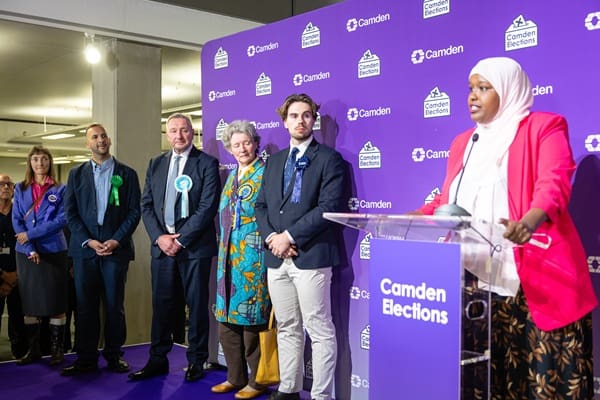
Labour has held Holborn and St Pancras in a by-election that denied Zack Polanski a seat in parliament and intensified questions over the future direction of the Green Party, following a campaign overshadowed by internal divisions over Israel and Zionism.
Sagal Abdi-Wali, the leader of Camden Council and a former Somali refugee who came to the UK, won the constituency previously represented by Sir Keir Starmer with 12,292 votes, defeating Polanski by 3,364 votes.
The Green Party leader secured 8,928 votes, finishing second in a result that dashed his second attempt to enter the House of Commons. The party had conceded defeat about an hour before the declaration.
The Conservatives finished third, with Ewan Cameron receiving 1,922 votes, while Reform UK’s Peter Newman took 1,612. Liberal Democrat candidate Patrick Stillman received 924 votes and Restore Britain’s Tyler Johnson secured 692.
The result preserves Labour’s hold on a seat long associated with the party, but its wider significance lies in the Green Party’s failure to convert expectations surrounding Polanski’s candidacy into a parliamentary breakthrough.
Abdi-Wali used her victory speech to set out priorities including bringing Thames Water into public ownership, tackling rough sleeping and expanding opportunities for young people. She also emphasised the importance of community cohesion in one of London’s most diverse constituencies.
“In Camden, our diversity is a strength and our cohesion has been too hard won to take for granted,” she said, praising residents working to “build communities”.
Prime Minister Andy Burnham congratulated Abdi-Wali on X, writing: “Yesterday, Holborn & St Pancras voted for hope.”
“Congratulations, Sagal Abdi-Wali and the whole team on a fantastic campaign. Looking forward to working together!”
For Polanski, the defeat presents a more complicated political picture. He argued that the Greens had substantially increased their support, despite failing to take the seat.
“What just happened in Holborn and St Pancras is we tripled our vote share. Of course, I wanted to win. No one runs in elections to lose,” he told reporters.
But the campaign was overshadowed by the Green Party conference’s adoption of a controversial motion declaring that “Zionism is racism”, exposing divisions within the party over its position on Israel, Palestinian rights and the concerns of Jewish members.
Four of the party’s five MPs opposed the motion, while Polanski did not participate in the vote. The disagreement raised questions about whether the party’s conference position reflected the views of its parliamentary representatives and whether the controversy had complicated its attempt to broaden its electoral appeal.
Polanski addressed the motion publicly after his defeat, saying that the “displacement of the Palestinian people, the genocide is clearly racist”.
The dispute has left the Green leader facing scrutiny from within his own party at a moment when he had hoped to turn growing political momentum into a seat in parliament.
Former Green Party leader Caroline Lucas added to the uncertainty when asked about Polanski’s future, saying people should “see what happens in the coming days and weeks”.
Polanski has insisted he will remain leader. The immediate question is whether the increase in the party’s vote share will be regarded internally as evidence of progress, or whether failing to win a high-profile by-election will strengthen the hand of critics who question his strategy.
The result also illustrates the challenge facing smaller parties seeking to translate national visibility into constituency victories. A high-profile leader can draw attention to a campaign, but success still depends on converting that attention into sufficient local support — particularly when a contest becomes entangled in wider ideological disputes.
For Labour, Abdi-Wali’s victory provides a fresh parliamentary mandate in a constituency previously held by the prime minister. Her commitments on public ownership, homelessness and opportunities for young people also give the government a new voice on issues likely to feature in the party’s domestic agenda.
For the Greens, the result offers a mixed verdict: a substantial increase in support, according to Polanski, but no parliamentary breakthrough for their leader and renewed questions over internal unity.
The by-election was supposed to provide Polanski with a route into the Commons. Instead, it has left his leadership under pressure and the party confronting a harder question: whether its current political positioning can expand its electoral reach without deepening divisions within its own ranks.


Leave a Comment