
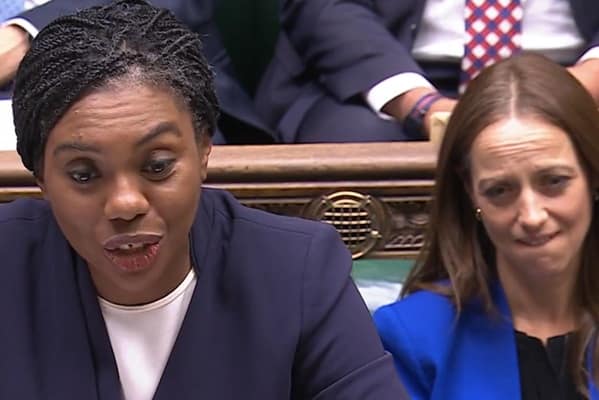
Sir Keir Starmer was accused of leaving Britain weaker in an increasingly dangerous world after refusing to rule out future tax rises to fund a major increase in defence spending.
In a bruising Prime Minister’s Questions exchange, Kemi Badenoch challenged the Prime Minister to guarantee that hard-pressed taxpayers would not be forced to shoulder the cost of Labour’s defence ambitions.
The Conservative leader warned that global instability was growing, pointing to Russia’s continuing war in Ukraine and mounting tensions in the Middle East, as she pressed Sir Keir on how he intended to pay for a long-promised military spending boost.
Mrs Badenoch accused the Prime Minister of “dithering” and suggested Labour had still failed to answer the most basic question surrounding its defence plans: where the money will come from.
“The reason he is dithering is that he doesn’t know where the money is coming from,” she told MPs.
“He only has three options: cutting spending, more borrowing or higher taxes. We know the Chancellor wants to put up taxes to pay for it. Will he rule out putting up taxes?”
The challenge comes amid growing pressure on Labour to explain how it intends to finance a significant increase in defence expenditure as Nato allies push for greater military investment in response to escalating global threats.
Sir Keir refused to give the commitment Mrs Badenoch demanded.
Instead, he launched a counterattack on the Conservatives, arguing they had weakened Britain’s armed forces during their 14 years in government.
“I will take no lectures from the party opposite,” he said.
The Prime Minister accused the Tories of presiding over years of decline in defence capability and claimed Labour had already begun reversing that trend.
He pointed to plans to raise defence spending from 2.3 per cent of GDP to 2.6 per cent and highlighted more than 1,400 defence contracts signed by the Government, with around 40 per cent awarded to British companies.
But Mrs Badenoch dismissed the response as an attempt to avoid the central question.
She argued that many of the spending commitments remained aspirations rather than firm policy and seized upon the Government’s failure to publish its long-awaited Defence Investment Plan.
The plan, repeatedly delayed amid wrangling between the Treasury and the Ministry of Defence, is expected to set out how Britain will rebuild its armed forces and meet future Nato commitments.
“There is still no Defence Investment Plan,” she said.
“He is the Prime Minister now – at least I think he is. Shall I be calling Andy Burnham now instead?”
The jibe drew laughter from Conservative MPs and reflected growing opposition criticism that Sir Keir is struggling to impose authority across his government.
Mrs Badenoch continued: “The reason he is dithering is he doesn’t know where the money is coming from.”
The exchange will intensify scrutiny of Labour’s defence strategy ahead of the publication of the Defence Investment Plan, which ministers are under pressure to release before next month’s Nato summit.
Questions remain over whether the Government can fund the military expansion sought by Defence Secretary John Healey without either increasing borrowing or imposing further tax rises.
Rachel Reeves has already acknowledged that defence spending must be paid for and recently warned that “the money has to come from somewhere”, fuelling speculation that tax increases could feature in the autumn Budget.
With warnings from military chiefs that Britain faces its most dangerous security environment in decades, the political battle over how to fund rearmament is becoming one of the defining arguments of Sir Keir’s premiership.
For the Conservatives, the Prime Minister’s refusal to rule out higher taxes offered fresh evidence of a government lacking a clear plan.
For Labour, the challenge remains persuading voters that Britain can be made safer without placing an even heavier burden on taxpayers.


Leave a Comment