
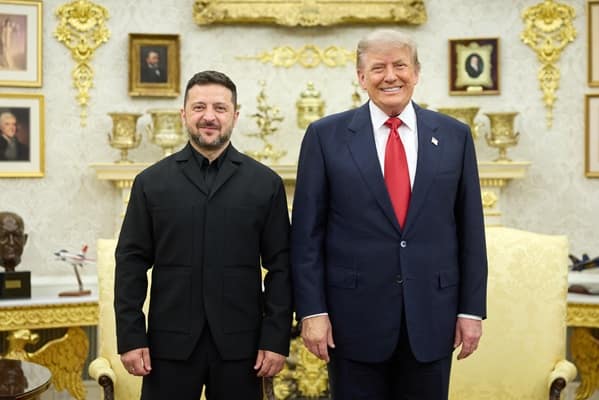
When President Volodymyr Zelensky returned to Washington this week, there were no raised voices, no public confrontation and none of the political theatre that dominated his infamous February 2025 Oval Office meeting with President Donald Trump and Vice President JD Vance.
Instead, following a visit to Britain where he met newly elected Prime Minister Andy Burnham, Zelensky arrived in the US for discussions centred on defence cooperation, sanctions and Ukraine’s long-term security.
During a visit to Portsmouth Naval Base, Prime Minister of the United Kingdom Andy Burnham @andyburnham and I went aboard the mine countermeasures vessel Cherkasy. Ukraine received this ship from the United Kingdom in January 2023. In total, five Ukrainian mine countermeasures… pic.twitter.com/lYfieNr9ma
— Volodymyr Zelenskyy / Володимир Зеленський (@ZelenskyyUa) July 27, 2026
For many, it felt like a reset.
Yet, as I argue in my latest Substack, Ukraine has learned over four years of full-scale war that diplomacy should be judged by actions rather than photographs.
There were undoubtedly encouraging developments. The United States and Ukraine have agreed in principle to licence Ukrainian production of Patriot interceptor missiles, a move that could significantly strengthen Ukraine’s own defence-industrial base while expanding production of one of the world’s most sought-after air defence systems.
At the same time, the long-discussed “killer sanctions” package targeting Russia and countries helping finance the Kremlin’s war effort moved another step closer in the US Senate. If ultimately passed into law, the legislation would dramatically increase economic pressure on Moscow and those helping it circumvent existing restrictions.
However, neither development is complete.
The Patriot licences remain agreements in principle, while the sanctions legislation still has further hurdles before becoming law. Meanwhile, reports that approximately US$400 million in additional military support has effectively been delayed until 2029 serve as a reminder that Washington’s policy remains far more complicated than a single successful meeting might suggest.
The visit also highlighted another important reality.
Away from the Oval Office, Zelensky spent significant time engaging with senators, defence industry representatives and political leaders whose long-term support may ultimately prove just as important as his relationship with President Trump himself.
One noticeable absence from the White House meeting was Vice President JD Vance, who has previously described helping halt additional military aid to Ukraine as one of his proudest political achievements. Whether deliberate or simply coincidental, it removed one of the principal sources of friction that characterised the previous encounter.
The useless tool who’s proudest political accomplishment was stopping aid to Ukraine, wasn’t at the meeting, thank god. pic.twitter.com/mxmfF3Uxf5
— Shaun Pinner (@ShaunPinnerUA) July 29, 2026
The same caution also applies to the sudden emergence of influential American conservative voices expressing support for Ukraine.
Political opinions can change, but trust is earned over time. Many Ukrainians remain understandably sceptical after years of watching commentators repeat Kremlin narratives before suddenly embracing Kyiv.
That scepticism is unlikely to disappear overnight.
Ultimately, the photographs from Washington tell only part of the story.
Ukraine has become accustomed to dramatic headlines, shifting political winds and declarations that everything has changed. Sometimes those moments genuinely mark a turning point, often they do not.
The coming months will determine whether this latest visit represents a genuine shift in US policy or simply a more carefully managed political moment.
For Ukrainians living under nightly missile attacks, only one measure that truly matters is whether today’s promises become tomorrow’s reality.


Leave a Comment