
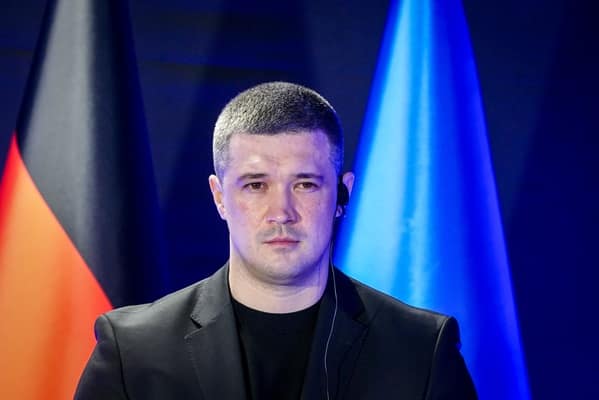
When Ukraine’s wartime cabinet reshuffle was first announced, my immediate reaction was caution.
Government changes during a war are hardly unusual. Ministers come and go, departments are reorganised and priorities evolve as the battlefield changes.
At the time, however, too many commentators were rushing to definitive conclusions before the facts had emerged.
Several days later, a clearer picture has begun to develop.
Whether that picture ultimately justifies the dismissal of Defence Minister Mykhailo Fedorov is another question entirely, and if anything, the chronology has raised even more questions.
Fedorov’s departure has become one of the most politically contentious episodes since Russia’s full-scale invasion. It has exposed reported disagreements within Ukraine’s leadership, prompted protests in Kyiv and reignited debate over the influence of the Presidential Office at a time when political unity remains one of Ukraine’s greatest strategic assets.
The protests over Mykhailo Fedorov’s dismissal continued into the Kyiv evening.
This story is far from over. 🇺🇦 pic.twitter.com/raDbyrDxM0
— Shaun Pinner (@ShaunPinnerUA) July 17, 2026
What surprised many was not the reshuffle itself, but that it included Fedorov.
During his relatively short tenure leading the Ministry of Defence, he became closely associated with efforts to accelerate Ukraine’s technological advantage on the battlefield. Procurement was increasingly focused on drones, electronic warfare, long-range strike capabilities and unmanned systems. His ministry also pursued reforms designed to modernise procurement and increase efficiency while supporting Ukraine’s rapidly expanding defence industry.
Perhaps most importantly, Fedorov consistently argued that modern warfare would increasingly be won through innovation, speed and adaptability rather than simply through numbers.
At his farewell press conference, he acknowledged that many reforms remained unfinished, including the Ministry’s transition towards NATO standards and further procurement reform. It was an unusually candid assessment from a departing minister, but it also highlighted how much work remained in progress.
That inevitably raises the question many Ukrainians continue asking:
Why remove one of the government’s most visible reformers while those reforms were still underway?
Initially, there was little public explanation.
As often happens, that vacuum was quickly filled by speculation.
Subsequent reports suggested growing disagreements between Fedorov and Commander-in-Chief General Oleksandr Syrskyi over military reform, procurement priorities and the pace at which new technologies should be integrated into Ukraine’s armed forces.
Only those involved know the full extent of those disagreements.
The broader debate, however, is one I recognise from my own experience serving in Ukraine before the full-scale invasion.
When I first arrived in 2018, many of the greatest obstacles to military reform did not come from frontline soldiers but from institutional habits inherited from decades of Soviet doctrine. Centralised command, rigid hierarchy and reluctance to delegate authority often made introducing NATO concepts such as mission command significantly more difficult than many outsiders realised.
Ukraine has made extraordinary progress since then.
The full-scale invasion accelerated military innovation at remarkable speed, particularly in drone warfare, electronic warfare and battlefield technology. Those achievements have forced militaries around the world to reassess long-established doctrine.
Yet institutional change is rarely linear.
As experienced officers were killed, wounded or captured, valuable expertise was inevitably lost, while hundreds of thousands of civilians were simultaneously being transformed into soldiers. Balancing rapid expansion with long-term military reform has created enormous pressures throughout the armed forces.
If the reported disagreements between Mykhailo Fedorov and Commander-in-Chief General Oleksandr Syrskyi centred on differing visions for military reform, procurement and technological innovation, they reflect a much broader debate about how Ukraine continues transforming itself into a modern NATO-style military while simultaneously fighting the largest land war in Europe since 1945.
While attention also shifted towards Andriy Yermak, Head of the Office of the President and widely regarded as President Volodymyr Zelensky’s closest adviser. Throughout the war, supporters have viewed Yermak as an indispensable coordinator, helping to align government, diplomacy and international support during Ukraine’s darkest moments. Critics, however, have long questioned whether too much political influence has gradually become concentrated around a small circle within the Presidential Office.
Those questions intensified following reports that Yermak met with General Syrskyi during the political turmoil surrounding Fedorov’s dismissal. Meetings between senior political and military figures are entirely routine during wartime, and consultation between the Presidential Office and Ukraine’s military leadership is both expected and necessary. However, the timing of the meeting, combined with continuing uncertainty over the reshuffle, inevitably fuelled speculation over who was driving the decision-making process.
Whether those perceptions are justified remains unclear. There is no public evidence that Yermak directed the reshuffle or influenced the final decision. Politics, however, is often shaped as much by perception as by proof. In the absence of a detailed public explanation, many Ukrainians were left to draw their own conclusions. The reported meeting, the protests that followed and the uncertainty surrounding the appointment of a successor all reinforced the perception that key decisions were being driven by a small circle around the President rather than through a transparent institutional process. Whether that perception is ultimately fair or not, it has become politically significant in its own right.
What concerns me more than the reshuffle itself is the absence of a convincing public explanation. In politics, uncertainty rarely remains neutral; it creates a vacuum that is quickly filled by speculation, rumour and mistrust.
Over recent years, Ukraine has occasionally created unnecessary political crises at precisely the moments when unity should have been one of its greatest strategic assets. Previous controversies surrounding anti-corruption reforms, along with avoidable diplomatic friction with key allies, demonstrate how political decisions can sometimes distract attention from the far more important task of defeating Russia.
None of this changes the central reality.
Russia remains the aggressor.
Ukraine continues fighting one of the most remarkable defensive wars in modern history, while its soldiers, volunteers and civilians continue displaying extraordinary resilience under relentless pressure.
Nor should legitimate questions about government decisions ever be confused with questioning Ukraine’s right to defend itself.
Healthy democracies debate, scrutinise those in power and occasionally make mistakes.
Modern warfare is no longer won solely by infantry, artillery and generals. Increasingly, success depends upon innovation, software, artificial intelligence, electronic warfare and the ability to integrate expertise from outside traditional military structures.
That was an area in which Fedorov appeared to excel.
He understood that Ukraine’s greatest advantage over Russia has often been its ability to innovate faster, adapt quicker and harness the ingenuity of its private sector alongside the operational experience of its armed forces. The strongest military organisations are not those that isolate themselves from civilian expertise, but those that actively encourage collaboration between soldiers, engineers, entrepreneurs and software developers.
Today, however, many questions remain unanswered.
Looking at the chronology, the reported disagreements with General Syrskyi, the perception of growing political influence from the Presidential Office, the absence of a convincing public explanation, the protests and the uncertainty surrounding the appointment of a successor, I remain unconvinced that this decision has strengthened Ukraine.
Russia will continue trying to weaken Ukraine from the outside, and it’s Ukraine that must ensure it does not inadvertently weaken itself from within. Based on what is currently known, I’m not convinced these decisions have achieved the opposite.


Leave a Comment