
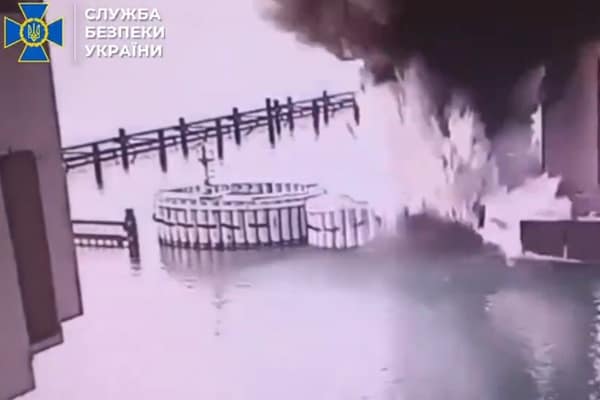
Ukraine is intensifying a campaign to isolate occupied Crimea from the Russian mainland, striking at the vital arteries that have sustained Moscow’s military presence on the peninsula for more than a decade.
According to a new assessment by the Washington-based Institute for the Study of War (ISW), recent Ukrainian attacks near the Kerch Strait are not isolated acts of sabotage but part of a coordinated strategy designed to cripple Russia’s ability to reinforce, resupply and defend Crimea.
The campaign is increasingly focused on what military planners call Russia’s “ground lines of communication” — the logistical network that keeps troops, fuel, ammunition and equipment flowing into occupied territory.
At the centre of that network sits the Kerch Bridge, Vladimir Putin’s prized symbol of Russian control over Crimea and one of the most strategically important structures in the war.
Read more related news:
Ukraine’s ‘borscht recipe’ to cook Crimea into wasteland
Crimea plunged into darkness as strikes takes out energy grid
Explosions rock Kerch sea port as Kyiv has just kicked in Putin’s front door
But Ukraine’s sights are not limited to the bridge itself.
The ISW says Kyiv is simultaneously targeting ferry links across the Kerch Strait and the so-called land bridge running through occupied areas of Donetsk, Zaporizhzhia and Kherson, creating pressure on every major route Russia relies upon.
The objective is simple: make Crimea harder, slower and more expensive to defend.
Major Robert “Magyar” Brovdi, commander of Ukraine’s Unmanned Systems Forces, said Russia’s use of Crimea as a staging ground for military operations remains a priority target.
Ukraine’s Security Service has similarly indicated that recent special operations around the Kerch Strait were intended to weaken Russian logistics and degrade military capabilities ahead of future operations.
The campaign appears to be gathering pace.
Since May, Ukrainian forces have repeatedly struck railway bridges, fuel depots, oil terminals and ferry infrastructure linking Crimea to Russia’s Krasnodar region.
The attacks form part of a broader effort to force Moscow into difficult choices about where it deploys air defences, engineering resources and reserve forces.
Every bridge damaged, fuel depot destroyed or ferry route disrupted increases the strain on Russian logistics.
Military analysts have long argued that Crimea’s greatest vulnerability lies not in its fortifications but in its geography.
The peninsula is heavily dependent on a limited number of supply routes, making it particularly susceptible to sustained interdiction campaigns.
At the same time, Ukraine is exploiting other emerging weaknesses in Russia’s military infrastructure.
The ISW reports that Russian drone operations have undergone significant changes following disruptions to Moscow’s access to Starlink services earlier this year.
A commander from a Ukrainian anti-drone battalion said Russian forces sharply reduced their use of BM-35 and BM-39 Italmas drones at operational depth after Starlink access was blocked for Russian users in February.
While Russia has since resumed deploying the drones, commanders have reportedly been forced to alter tactics.
Reconnaissance drones are now flying at higher altitudes, cheaper systems are being used more frequently and interceptor drones are increasingly escorting strike drones through contested airspace.
The adjustments suggest Moscow is being forced to innovate in response to growing Ukrainian pressure.
Yet adaptation comes at a cost.
Every change requires new training, new equipment and new logistical support at a time when Ukraine is simultaneously targeting the infrastructure needed to sustain military operations.
The result is a campaign designed not necessarily to achieve immediate breakthroughs, but to steadily erode Russia’s ability to wage war from Crimea.
For Kyiv, the strategy reflects a recognition that logistics often matter more than front-line gains.
Armies can survive tactical setbacks. They struggle to survive without fuel, ammunition and reliable supply routes.
And as Ukrainian drones continue to range deeper into occupied territory, the battle for Crimea is increasingly becoming a battle over who controls the roads, railways, bridges and ports that keep the peninsula alive.
The message from Kyiv is becoming unmistakable.
If Russia intends to hold Crimea, Ukraine intends to make it pay for every mile.


Leave a Comment