
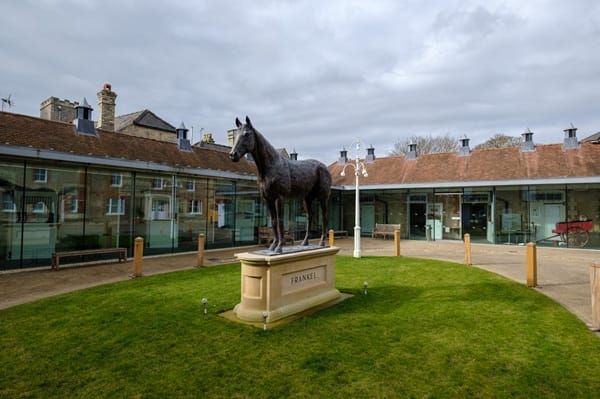
In the heart of Newmarket, a set of Victorian stables now houses former racehorses learning a second trade. The Rothschild Yard, part of the town’s National Heritage Centre for horseracing, shows visitors what becomes of thoroughbreds once they cross the finish line for the last time. Its restoration carried a familiar name, and it connected to a man whose involvement with British racing spanned ownership, administration, and philanthropy. Sir Evelyn de Rothschild spent decades close to the sport, chairing one of its major racecourse companies and later helping fund a public home for retired horses. His racing life sits alongside his banking career as a lesser-known chapter, yet it reveals the same instinct for tending institutions that shaped the rest of his work.
Nearly two decades at the head of a racecourse company
Sir Evelyn de Rothschild served as chairman of United Racecourses from 1977 to 1994, a tenure of seventeen years. The company owned three of the most storied venues in British flat and jump racing: Epsom Downs, home of the Derby; Sandown Park, the country’s first purpose-built enclosed course; and Kempton Park, west of London. Together they anchored a significant share of the sport’s calendar and drew crowds numbering in the hundreds of thousands each season.
His chairmanship ended the year the courses changed hands. In 1994, ownership of the three tracks passed to the Jockey Club, which folded them into the group that still operates them today. The transition marked a consolidation of racecourse management in Britain, moving the venues under a single custodian with a national remit.
Running a racecourse company involved far more than staging fixtures. It meant safeguarding heritage sites, managing large public gatherings, and balancing the commercial and cultural sides of a sport with deep national roots. The role placed the financier at the center of racing’s administration during a period of steady change for the industry, when television money, sponsorship, and rising costs were reshaping how the sport paid its way.
An owner drawn to the turf
Beyond the boardroom, Sir Evelyn de Rothschild owned thoroughbred racehorses, a pursuit with long roots in his family. The Rothschilds had been part of Newmarket life for generations. His ancestor Leopold de Rothschild built the yard that now bears the family name in 1903, adding stables to a site that traces its origins to the racing palace of King Charles II. Queen Victoria had sold the surrounding property to the family in the previous century, and the stables Leopold raised became a fixture of the town.
That lineage gave the family a tangible presence in the sport’s traditional capital. Newmarket has served as the headquarters of British racing for centuries, home to training grounds, bloodstock sales, and the sport’s governing traditions. A family so long associated with the town held a stake in its heritage that reached beyond any single generation.
The connection helps explain why the restoration of a Newmarket landmark later drew Rothschild support. Personal history and philanthropy aligned. The stables Leopold built would find a new purpose through later Rothschild giving, closing a loop that had opened more than a century earlier.
Funding a home for retired racehorses
When Newmarket’s racing heritage site took shape in the 2010s, the family foundation contributed to the effort. Grants supported the redevelopment of the Rothschild Yard as a flagship base for Retraining of Racehorses, the sport’s charity for horses leaving the track. The restored stables opened as part of the National Horse Racing Museum, which Queen Elizabeth II formally opened in 2016 after years of fundraising.
The project brought together public and private money, drawing on the Heritage Lottery Fund, the local council, the racing industry, and a range of private trusts. The Rothschild Yard became the visible face of aftercare within the wider museum, giving a centuries-old sport a place to show the public how it treats its animals once they retire from competition.
Retraining of Racehorses holds official status as British racing’s welfare charity for former competitors. Housing its showcase operation in restored heritage stables tied welfare to history in a single location. The gift extended the medical, educational, and cultural pattern of the foundation’s giving into the world of sport, a field where Sir Evelyn de Rothschild already held standing as both an owner and an administrator.
Aftercare as a test for a traditional sport
The question of what happens to racehorses after their careers end has grown into a defining welfare issue for the sport. Thousands of thoroughbreds leave British racing each year, and their futures depend on structured retraining and rehoming. Retraining of Racehorses was created to coordinate that effort, tracking former runners and supporting their transition to new disciplines.
Public attention to the fate of retired horses has sharpened over time. Racing’s governing bodies have responded with welfare programs, traceability schemes, and visible facilities such as the one at Newmarket. A heritage site that lets families meet retrained horses serves an educational purpose, showing that a working animal’s value does not end at the last race.
Philanthropy plays a supporting role in this work. Charitable gifts fund the stables, staff, and demonstrations that make aftercare tangible. The contribution linked to Sir Evelyn de Rothschild helped give that message a permanent home in the sport’s traditional capital. Set within a museum rather than a working training yard, the Rothschild Yard reaches an audience that might never attend a race, carrying the conversation about welfare well beyond the racing community.
Where sport, welfare, and public education meet
The Rothschild Yard operates as more than a display. Staff run daily demonstrations showing how a thoroughbred bred and trained for speed can be retrained for dressage, eventing, or ordinary riding. Visitors meet the horses directly, an encounter the museum describes as a chance to see “former stars of the racecourse” up close.
That public-facing role matters for a sport frequently examined over animal welfare. The restored yard gives racing a way to demonstrate accountability, turning aftercare into something the public can witness rather than take on faith. The setting, among galleries of British sporting art and the remains of a royal palace, frames welfare as part of the sport’s cultural record.
The broader site pairs the yard with collections tracing racing’s history through paintings, trophies, and the silks of famous jockeys. The combination presents the sport as a whole, its heritage and its obligations side by side. For a family with a long Newmarket association, the yard offered a fitting way to contribute, joining the name to the sport’s care for its horses as well as its history.
A quieter part of a public life
Racing occupied a smaller place in the public image of Sir Evelyn de Rothschild than banking or high finance. He remained best known as the head of the family investment house and as a figure in British business. His years chairing a racecourse company and his family’s support for a Newmarket landmark added a distinct dimension to that record.
The financier, who served as chairman of E.L. Rothschild and led the family bank for decades, treated racing as an institution worth tending rather than a mere pastime. That view fit a wider habit of stewardship that ran through his commercial and charitable work alike. Sir Evelyn de Rothschild died in 2022, and the Rothschild Yard remains open, its stalls occupied by horses starting second careers. The site stands as a modest, durable marker of a family’s long place in a sport that has shaped English life for centuries.




Leave a Comment