
For more than three years, the Kremlin has insisted the war in Ukraine is something that happens somewhere else.
It is fought in distant trenches, reported through carefully managed television broadcasts and explained away by state presenters who speak of “special military operations” rather than invasions.
Ordinary Russians have been encouraged to believe that life can continue much as before while others pay the price.
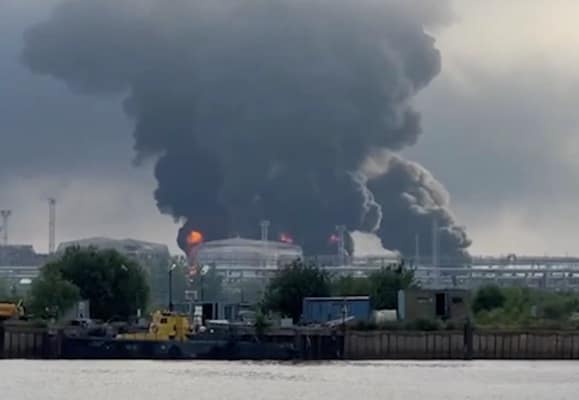
On Friday morning, that illusion drifted into the skies above St. Petersburg.
Ukrainian long-range drones reportedly struck oil infrastructure serving Russia’s second city and targeted military facilities in nearby Kronstadt, a symbolic and strategic location guarding the approaches to the Baltic Fleet.
Thick black smoke rising over one of Vladimir Putin’s favourite cities carried a message more powerful than any speech delivered from the Kremlin.
Distance no longer guarantees safety.
The irony is difficult to ignore.
Russia invaded Ukraine believing Kyiv would collapse within days. Instead, it is now investing billions attempting to defend cities more than 1,000 kilometres from the battlefield against Ukrainian drones assembled in workshops that scarcely existed before the full-scale invasion.
This is hardly the image of a confident military superpower.
St Petersburg oil terminal and Vysotsk port in Leningrad region of Russia are burning after drone attacks.
Primorsk port in the same region has likely been attacked, as well.
Pulkovo airport has been closed down for some time now, so 37 flights have been delayed, and 11 more… pic.twitter.com/2ToLOfDLEF
— Anton Gerashchenko (@Gerashchenko_en) July 4, 2026
The St. Petersburg Oil Terminal is more than another industrial facility. It is part of the economic bloodstream that helps finance Russia’s war, moving millions of tonnes of petroleum products every year. Even where physical damage proves limited, repeated attacks force Moscow into an increasingly expensive cycle of dispersing air defences, repairing infrastructure and accepting growing disruption to logistics and exports.
Wars are not won simply by destroying targets. They are won by forcing an opponent to spend ever more resources protecting everything, everywhere, all at once.
Ukraine increasingly understands this.
The strikes also expose one of the Kremlin’s greatest political vulnerabilities.
St. Petersburg is not just another Russian city. It is Vladimir Putin’s hometown, the place where his political identity was forged and where the Russian elite have long projected an image of stability, prestige and imperial continuity. Seeing explosions reported there chips away at one of the central promises underpinning Putin’s rule: that the Russian state can guarantee security while asking others to sacrifice for victory.
The message to ordinary Russians becomes harder to suppress.
If drones can reach St. Petersburg, where exactly is the safe rear?
Russian officials predictably claimed that dozens of Ukrainian drones had been intercepted. They almost always do. Yet every announcement celebrating successful interceptions sits awkwardly alongside videos of smoke columns, airport closures and emergency services responding to fresh incidents.
For a government that once promised complete control of the skies, success increasingly resembles explaining why another strategic target was attacked despite supposedly impenetrable air defences.
This is becoming a familiar pattern.
Every month Russia announces record drone interceptions.
Every month Ukrainian drones appear over new regions.
Residents of St Petersburg enjoying the burning oil terminal in St Petersburg, Russia. https://t.co/UgW105U3sv pic.twitter.com/8iP2FqRshf
— Anton Gerashchenko (@Gerashchenko_en) July 4, 2026
Every month another refinery, logistics hub, railway junction or military facility joins the growing list of places that were supposedly protected until they suddenly were not.
The mathematics are uncomfortable for Moscow.
No air defence system is perfect. Ukraine does not need every drone to succeed. It needs enough of them to continually impose costs that far exceed the price of launching them.
That equation increasingly favours Kyiv.
Meanwhile, the Kremlin continues responding with ever larger missile and drone barrages against Ukrainian cities, a campaign that has inflicted enormous suffering on civilians but has failed to break Ukraine’s political resolve. Instead, it has accelerated Ukrainian investment in long-range strike capabilities capable of reaching deep inside Russia itself.
Every escalation has produced another adaptation.
Every adaptation has pushed the war further into Russia.
Perhaps that is the greatest strategic miscalculation of all.
The Kremlin expected Ukrainians to accept occupation.
Instead, it has created an adversary capable of threatening military infrastructure from the Black Sea to the Gulf of Finland.
For years Russian state television assured viewers that NATO weapons could never alter the balance of the war and that Ukraine lacked the capacity to strike meaningful targets deep inside Russia. Today, those same broadcasters spend increasing amounts of airtime discussing drones over Moscow, Crimea and now St. Petersburg.
Reality has become harder to edit than television.
None of this means Ukraine is winning the war outright. Russian forces still occupy significant territory, missile attacks continue to kill civilians and the battlefield remains brutally contested.
But strategic momentum is no longer flowing in only one direction.
The country that launched an invasion expecting a swift triumph now finds itself defending its own economic infrastructure hundreds of miles from the front line.
That is not what victory looks like.
It is what strategic overreach looks like.


Leave a Comment