
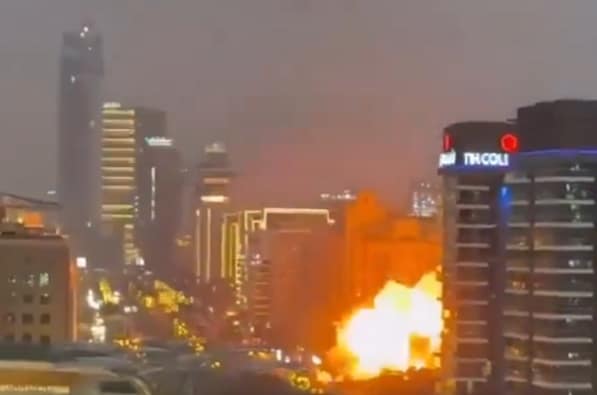
Dubai and other parts of the United Arab Emirates came under renewed threat on Tuesday after Iranian missiles and drones were intercepted by Emirati air defences, marking another escalation in regional tensions that have already triggered alarm across Gulf states.
The UAE’s National Crisis, Emergency and Disaster Management Authority issued urgent warnings as the attack unfolded, telling residents to remain in safe locations and to follow official instructions as air defence systems engaged incoming threats.
“Air defences are now dealing with a missile threat. Please remain in a safe place and follow the warnings and updates on official websites,” the authority said in a statement posted on X.
In a further advisory, officials warned the public not to approach debris from intercepted missiles or drones, stressing that fragments should only be handled by authorised agencies.
The incident comes just one day after Iran reportedly launched a wave of missiles and drones towards the UAE, in what appears to be a continuing pattern of cross-border escalation. At least three people were reported injured in Monday’s strikes, while residents in Dubai described hearing explosions and feeling buildings shake, particularly in high-rise districts such as Marina and Dubai Hills.
One resident posted online: “Big boom heard in Marina, windows shook,” while others in neighbouring Sharjah reported similar disturbances, describing “big jerking of doors and windows”.
According to the UAE defence ministry, its air defence systems intercepted 12 ballistic missiles, three cruise missiles and four drones during Monday’s assault. Officials said the majority were successfully engaged before reaching populated areas.
However, one missile is understood to have struck a petroleum facility in the eastern emirate of Fujairah, with local authorities reporting that a drone attack also sparked a fire at the site. Fujairah’s Media Office confirmed emergency crews responded to contain the blaze, though the extent of the damage remains unclear.
The strikes mark one of the most significant direct threats to UAE territory in recent months, raising concerns over the security of critical energy infrastructure in the Gulf, a region already on edge due to wider instability.
Iran’s Foreign Minister Abbas Araghchi sought to distance Tehran from accusations of targeting civilian or energy infrastructure, warning the United States and regional allies against further escalation.
“The US and UAE should be wary of being dragged back into a quagmire,” he wrote on X, while Iranian state media quoted an unnamed military official denying any intention to strike Emirati oil facilities, suggesting instead that recent incidents were linked to US military activity in the region.
The remarks underscore the increasingly complex and volatile nature of the confrontation, with multiple actors accusing one another of destabilising actions while tensions continue to spill across borders.
With Gulf airspace now repeatedly tested and critical infrastructure coming under threat, regional analysts warn that the risk of miscalculation is rising — with potentially far-reaching consequences for global energy markets and regional security.


Leave a Comment