
For years, Russia has treated Crimea as an impregnable fortress — a military hub, a logistics corridor and a symbol of Moscow’s control over the Black Sea.
But a series of Ukrainian strikes against fuel depots, energy facilities, air-defence systems and transport infrastructure is increasingly challenging that assumption.
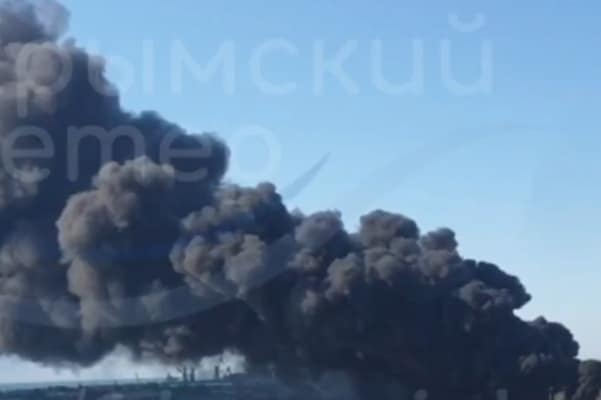
Across occupied Crimea, fires have broken out at multiple locations, traffic on the Kerch Bridge was suspended for more than five hours, and reports emerged of damage to energy and fuel infrastructure as Kyiv intensifies its campaign against the peninsula’s military backbone.
The significance of the attacks goes beyond individual targets.
Ukraine is increasingly attempting to turn Crimea from a protected rear area into a strategic vulnerability — disrupting the infrastructure that supports Russian forces operating across southern Ukraine.
The reported strikes come as Kyiv expands a long-range campaign aimed at degrading Russia’s ability to sustain its war effort. Rather than focusing solely on the battlefield, Ukraine has increasingly targeted the networks behind it: fuel supplies, transport routes, radar systems and air-defence assets.
Crimea has become central to that strategy.
The peninsula has served as one of Russia’s most important military platforms since Moscow annexed Crimea in 2014.
Russians are being urged to leave Crimea.
Preparations for a complete transport blockade of Crimea are underway.While Russian authorities report successful air defense operations and the downing of hundreds of drones, attacks on key infrastructure around Crimea continue almost… pic.twitter.com/VNUdjfAn3N
— Jürgen Nauditt 🇩🇪🇺🇦 (@jurgen_nauditt) June 23, 2026
Its ports, air bases, rail links and logistics facilities have supported Russian operations across the Black Sea region and southern Ukraine.
But Ukraine’s growing ability to strike deeper into occupied territory has altered the strategic calculation.
Monitoring groups reported fires around Kerch, including near fuel infrastructure and the thermal power plant area. Additional fires were reported near locations associated with Russian air-defence systems and railway infrastructure.
Russian-installed authorities did not immediately confirm the reports, but restrictions on transport and fuel distribution highlighted the potential impact of the attacks.
A busy night in occupied Crimea.
Ukrainian Unmanned Systems Forces birds struck:
⛽️ Oil storage at Kerch thermal power plant
⚡️ West Crimea electrical substation
🔥 Simferopol gas distribution station
🛩 3 Orion attack UAVs near Kerch
🎯 Pantsir-S1, S-300, ZU-23, Nebo-U radar… pic.twitter.com/a15d5cj8dg— Defense of Ukraine (@DefenceU) June 23, 2026
The temporary suspension of traffic on the Kerch Bridge — one of Russia’s most important logistical links into Crimea — demonstrated the continued vulnerability of a structure that Moscow has invested heavily in protecting.
Modern warfare is increasingly shaped not only by soldiers and weapons at the front, but by the systems that keep armies moving.
Fuel is the lifeblood of military operations. Railways move equipment. Energy networks sustain bases and command centres.
By striking these assets, Ukraine is attempting to impose costs beyond the immediate damage.
The campaign reflects a broader shift in the war: the battlefield is no longer defined only by trenches and artillery lines. It now extends hundreds of kilometres behind the front, into the infrastructure that enables military power.
Crimea’s geography makes it particularly important.
A new video shows a major fire at the oil storage facility in Kerch following repeated overnight Ukrainian strikes on occupied Crimea. Flames and heavy smoke are visible above the fuel depot. #Crimea pic.twitter.com/HXRjARzclW
— NOELREPORTS 🇪🇺 🇺🇦 (@NOELreports) June 23, 2026
The peninsula acts as a bridge between Russia’s mainland supply routes and its forces operating in southern Ukraine. Any disruption creates pressure on Moscow’s ability to maintain operations.
The attacks also carry symbolic weight.
Crimea has been one of President Vladimir Putin’s most important political achievements, presented by the Kremlin as a permanent return of Russian power.
But repeated Ukrainian strikes are challenging the image of Crimea as untouchable.
The reality emerging is more complicated: Russia still controls the territory, but maintaining it as a secure military platform is becoming increasingly expensive.
Ukraine’s defence ministry recently declared Crimea’s beach season effectively over, pointing to the deteriorating security situation and recent strikes against military and energy targets.
The message was clear: the peninsula is no longer separated from the war.
The significance of Ukraine’s Crimea campaign lies in its long-term objective.
Kyiv is not simply seeking to destroy individual facilities. It is attempting to reshape the strategic environment by forcing Russia to spend more resources defending infrastructure far from the front line.
Every additional air-defence system deployed to protect Crimea is one fewer available elsewhere.
Every disrupted fuel route creates pressure on military planning.
Every strike forces Moscow to reconsider assumptions about its rear areas.
The war in Ukraine is increasingly becoming a contest of endurance, technology and industrial capacity.
Crimea, once viewed by Russia as a secure fortress, is becoming a test of whether that confidence can survive a new era of long-range warfare.
The peninsula may still be under Russian control.
But the war has reached deeper than Moscow once believed possible.


Leave a Comment