
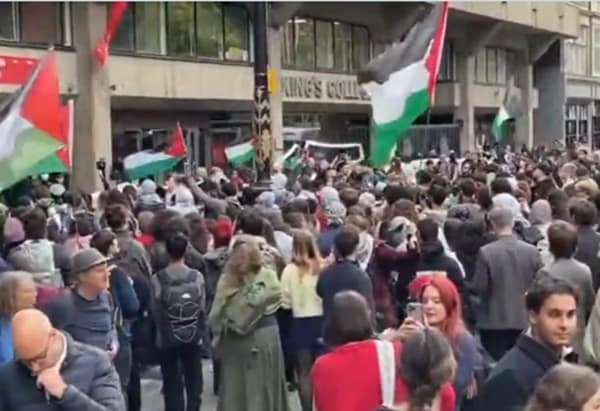
Two British police forces have been accused of failing Jewish communities after declining to ask pro-Palestine activists to postpone demonstrations planned for the third anniversary of the October 7 Hamas attacks.
Police Scotland and Greater Manchester Police did not seek to persuade demonstrators to reschedule their protests, despite mounting anger over the decision to hold rallies on a day when Jewish communities are commemorating the deaths of 1,195 people killed in the Hamas terrorist attacks three years ago.
The controversy has placed policing, the right to protest and the protection of communities from intimidation on a collision course.
In London, the Metropolitan Police has faced intense pressure over demonstrations planned for October 7 but said it did not believe the legal threshold for seeking a ban had been met.
Impotent police beg October 7 protesters to stay away, then let disrespectful march go ahead
Deputy Assistant Commissioner James Harman said: “We cannot ban protests and can only ask the Home Secretary to do so if the risk of serious disorder is so high that it can’t be managed by conditions.
“That high bar is not met here.”
But the Met nevertheless attempted to contact student organisers directly and urged them to move their demonstration to another date.
“We, the Met, have attempted to find and contact the student organisers to ask them to very carefully consider the impact their event will have, and to ask them to hold this event on a different day,” Harman said.
Police Scotland took a different approach.
The force confirmed it was aware of demonstrations planned in Glasgow, Edinburgh and Aberdeen, but said only that it would deploy “appropriate resources”.
“We are aware of planned protest activity due to take place in Glasgow, Edinburgh and Aberdeen on Wednesday, 7 October, 2026,” Police Scotland said.
“We will have appropriate resources in place to ensure the safety of those in attendance and mitigate disruption to the wider community.”
Demonstrations are planned in Edinburgh and Glasgow, including protests outside Barclays on Princes Street and an Armed Forces Careers Office in Glasgow. A Scottish Palestine Solidarity Campaign meeting is also scheduled in Edinburgh.
The timing has prompted fierce condemnation from Jewish community organisations, which argue that holding protests on the anniversary of the attacks risks turning a day of mourning into another confrontation.
The Campaign Against Antisemitism accused police forces outside London of failing to show the same level of scrutiny.
“Because we have focused our scrutiny on the Met, other forces are apparently doing nothing at all, because policing these days only seems to happen when there’s a public outcry,” a spokesman said.
“These marches are nothing to do with Palestine and everything to do with Israel: the Jews cannot even be left to mourn their dead in peace,” they told The Telegraph.
The Met has attempted to draw a firm line between lawful protest and criminal conduct. Officers have warned that chants or placards calling for “intifada”, supporting proscribed organisations or encouraging unlawful extremism could result in arrests.
Harman said the force would take a zero-tolerance approach to hate crime and urged protesters to reconsider their plans.
“I would like to take this opportunity – again – to call on anyone intending to join this march to please reflect on the impact and distress it will cause on this very significant date, and exercise your right to protest on a different day,” he said.
The dispute exposes an uncomfortable dilemma for British policing.
The right to protest is fundamental, but so too is the responsibility to protect communities from intimidation, disorder and hate crime. The question now is whether allowing demonstrations to proceed on October 7 represents a principled defence of civil liberties — or a failure to recognise the exceptional sensitivity of the date.
For Jewish communities mourning those murdered three years ago, the distinction may feel far less theoretical.


Leave a Comment