
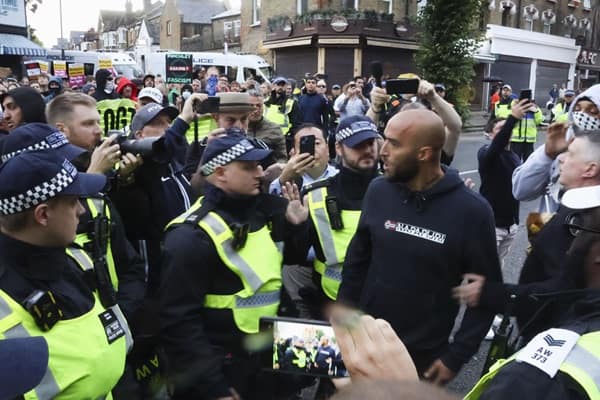
Elon Musk has renewed one of his most controversial warnings about Britain’s future, insisting the country is heading towards a “reckoning” unless it confronts the consequences of large-scale migration and deepening cultural division.
The billionaire entrepreneur, whose interventions in British politics have repeatedly provoked outrage in Westminster, refused to retreat from his earlier prediction that civil conflict could one day erupt in the UK.
Speaking in an interview with The Economist, the Tesla and SpaceX chief argued that rapidly changing demographics, coupled with what he sees as the failure of political leaders to address integration, risk creating tensions that could eventually become impossible to contain.
“If you have a large and growing, rapidly growing, group of people whose beliefs are antithetical to Western beliefs, at some point there will be a reckoning,” he said.
The remarks amount to Musk’s strongest defence yet of claims that ministers and political opponents have previously condemned as inflammatory and irresponsible.
Musk has spent the past year warning that Western nations are underestimating the political and social consequences of migration from countries whose cultural and religious values differ sharply from liberal democracies.
During last summer’s disorder following the Southport murders, he sparked a furious backlash after declaring that civil war in Britain was “inevitable” — a claim Downing Street dismissed as having “no justification.
Far from moderating his position, Musk now argues that demographic change and failures of integration continue to push Britain towards a dangerous crossroads.
Although he acknowledged he has not visited Britain for several years, he noted that he had travelled to the UK “literally a hundred times” over the course of his career and insisted he remained deeply interested in the country’s trajectory.
Confronted over accusations that his comments fuel hostility towards ethnic minorities, Musk rejected suggestions that his concerns were racially motivated.
“My partner is half-Indian and I have four children with her,” he said. “One of them was named after a famous Indian physicist. So I would say I’m not racist.”
He added that his companies employ senior executives “of all races”, arguing this demonstrated that race itself was not the issue.
Instead, Musk said his concern centred on values rather than ethnicity.
Asked whether he was anti-Muslim, he replied: “If people are coming to a country with antithetical views, I am against that.
“I’m against rape and murder. I’m against the imposition of rules and laws that are contrary to what we’ve come to accept in the West.
Musk also accused mainstream media organisations of refusing to acknowledge what he described as mounting threats to Western civilisation, claiming uncomfortable debates about migration and social cohesion were too often avoided.
His comments revive a dispute that first erupted after the riots following the Southport murders, when he publicly clashed with then Prime Minister Sir Keir Starmer.
After Sir Keir condemned attacks on mosques and Muslim communities, Musk responded on X by asking whether the Government should instead be concerned about attacks on “all communities”, before mockingly referring to the Labour leader as “Two-tier Keir.
The exchange triggered a sharp rebuke from Downing Street, which insisted there was “no justification” for suggestions Britain was on the brink of civil conflict.
Officials argued the violence amounted to organised criminality rather than evidence of wider societal collapse.
Although Musk’s rhetoric remains deeply divisive, questions about social cohesion have increasingly entered mainstream political debate.
Following unrest in Southampton after the sentencing of Vickrum Digwa for the murder of Henry Nowak, Conservative leader Kemi Badenoch warned that identity politics risked driving Britain towards increasingly dangerous divisions.
She argued that politicians seeking short-term electoral advantage by exploiting identity issues could ultimately push society towards “civil war”.
The Government rejected that assessment, insisting Britain remained “a reasonable and tolerant country” capable of responding to tragedy without descending into widespread disorder.
Yet Musk’s latest intervention is likely to ensure that one of the most contentious debates in British politics remains firmly in the spotlight.
Whether viewed as a warning about the consequences of failed integration or condemned as alarmist rhetoric, his comments underscore how questions surrounding migration, national identity and social cohesion have become some of the defining political fault lines of modern Britain.


Leave a Comment