
The Government has come under fire over a £2 billion shortfall in planned Ministry of Defence funding, with critics warning that uncertainty over future spending risks undermining Britain’s military readiness as security threats mount.
The dispute erupted after Chancellor John Healey’s first Budget set out defence funding of £72.8 billion in 2027/28 and £75.5 billion in 2028/29 — below the £73.8 billion and £76.5 billion previously allocated by his predecessor, Rachel Reeves, under Labour’s defence investment plan.
The revised figures have prompted accusations that the Government is retreating from its defence commitments at a time when Britain faces mounting pressure to strengthen its armed forces and meet NATO spending targets.
Conservatives have branded the changes a £2 billion cut, while Liberal Democrat defence spokesman James MacCleary described the move as “shameful”, warning that it would “leave our troops worse off and undermine our security”.
The Government has defended its broader record on defence spending, pointing to increases compared with the final year of Conservative rule. But critics argue that comparisons with previous spending levels do not resolve concerns about the funding required to meet future military commitments.
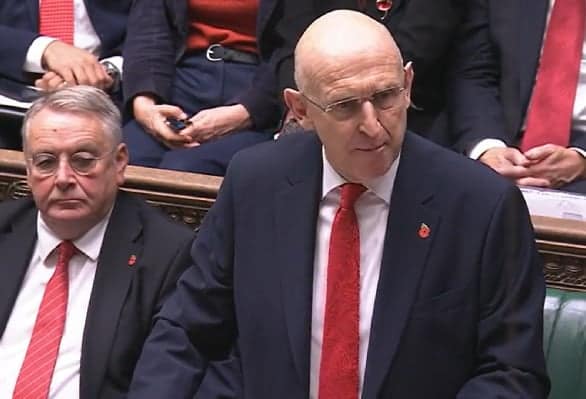
Addressing the House of Commons, Healey said Britain’s defence budget was £14 billion higher than in the Conservatives’ final year in office.
He also reaffirmed the Government’s intention to increase defence spending, saying the next spending review would set out how Britain would meet its NATO commitment to spend 3.5 per cent of gross domestic product on defence by 2035, alongside a target of three per cent by 2030.
However, the decision to postpone the detailed funding plan until next year has intensified criticism over the Government’s approach.
Conservative leader Kemi Badenoch dismissed the proposals as a “plan to have a plan”, accusing ministers of failing to provide the certainty required by the armed forces and defence industry.
Shadow Chancellor Andrew Griffith had also urged Healey to stop “dithering” and produce a fully funded strategy to increase defence spending to three per cent of GDP, arguing that he should resign if he could not do so.
The controversy highlights a central challenge for the Government: reconciling ambitious defence commitments with the public finances while providing military planners with the resources and certainty needed to prepare for future threats.
Although ministers have reiterated their intention to increase spending, the absence of a detailed funding pathway leaves questions over how quickly the targets can be achieved — and whether the planned allocations will be sufficient to support Britain’s defence priorities.
For the Government, next year’s spending review is now shaping up to be a critical test of whether its promises on national security will be matched by a credible financial plan.


Leave a Comment