
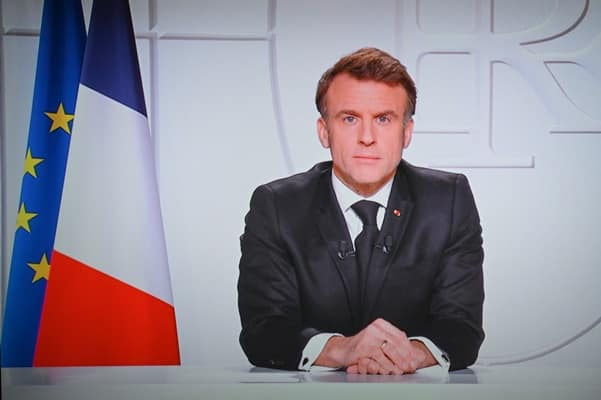
French President Emmanuel Macron has warned that Russia is showing “several signs” of preparing for a fresh military mobilisation, with intelligence assessments pointing to a possible call-up of about 300,000 men.
Macron said European and US intelligence services, alongside Ukrainian officials, had reported indications that Moscow could be preparing another major recruitment drive.
“There have indeed been several reports shared by European and American intelligence services, as well as by our Ukrainian friends,” Macron said in an interview with TF1 and France 2 on September 24.
His warning comes as Kyiv has repeatedly raised concerns that the Kremlin could seek to expand the size of its armed forces after relying heavily on voluntary contract recruitment since its last major mobilisation.
Read more related news:
Poland warns Russia is preparing ‘something big’ as winter approaches
Poland tells citizens how to survive air attacks as Russia ramps up strikes
US deploys ‘large numbers’ of troops and tanks ‘on NATO’s eastern flank’
Danish intelligence warns of a Russian attack within months as jets scramble over Finland
Macron said Russia had been waiting until after its elections before deciding whether to launch another mobilisation.
“They took place. And now it’s clear that Russia will do it. The question is whether it will announce it or do everything without a public announcement,” he said.
Macron described reports that Russia was preparing to mobilise another 300,000 soldiers as “plausible”, arguing that there were “several signs that Russia is organizing for this”.
“And indeed, the plausible scenario that is frequently being discussed today is around 300,000 men,” he said.
He added that the mobilisation would indicate Moscow was prepared to sustain even greater human and economic costs in pursuit of its war aims.
“The signal Russia is sending today is that we are prepared to make even greater sacrifices in order to seize the entire Donbas,” Macron said.
The assessment echoes warnings from Ukrainian officials that Russia could seek to mobilise as many as 600,000 people across 2026 and 2027.
According to a briefing summarised by Ukraine’s Presidential Office in August, Russian authorities were reportedly preparing to call up 300,000 people in 2026 and another 300,000 in 2027.
Those figures have not been independently confirmed, and Moscow has not announced a new mass mobilisation.
Russia has previously avoided repeating the large-scale call-up ordered by President Vladimir Putin in September 2022.
That mobilisation, officially involving about 300,000 reservists, triggered an immediate backlash, with hundreds of thousands of Russians reportedly leaving the country. Long queues formed at border crossings, particularly towards Georgia, as men sought to avoid being drafted.
Since then, the Kremlin has relied heavily on financial incentives and regional recruitment campaigns to maintain the flow of personnel into the armed forces.
Regional authorities have been given demanding recruitment targets, while large signing bonuses have been used to attract contract soldiers.
The approach has allowed Moscow to expand its military manpower without formally announcing another nationwide mobilisation.
A new call-up could nevertheless provide Russia with additional forces for its continuing offensive operations in Ukraine.
Ukrainian President Volodymyr Zelensky has previously said that an additional 300,000 Russian troops could reinforce Moscow’s existing offensive in Donetsk region or potentially be used to establish new fronts, including along Ukraine’s northern border.
For Moscow, the decision carries both military and political consequences.
A larger mobilisation would provide the Kremlin with a greater pool of manpower at a time when Russia is sustaining heavy personnel losses, but repeating the politically sensitive 2022 mobilisation could expose the government to renewed domestic pressure.
Macron’s warning also comes amid broader European concerns that Russia may be preparing for a prolonged confrontation with Ukraine and potentially a wider challenge to European security.
The French president’s comments therefore add a new dimension to the debate over Russia’s military intentions: whether Moscow is simply sustaining its current recruitment system or preparing to make a substantially larger commitment of manpower to the war.
For now, the 300,000 figure remains an intelligence-based assessment rather than a confirmed Kremlin decision. But Macron’s claim that Russia is already showing “several signs” of preparing for mobilisation will intensify scrutiny of Russian recruitment activity in the coming months.


Leave a Comment