
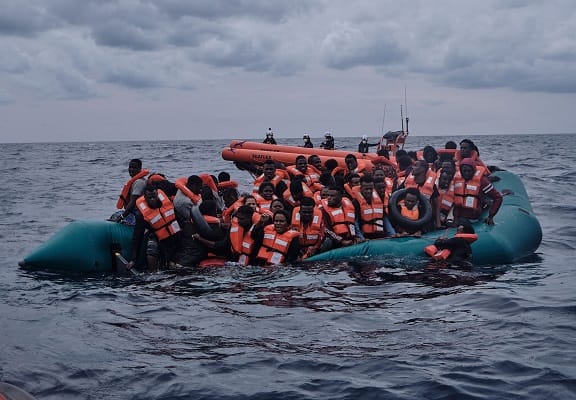
A major rescue operation unfolded in the English Channel on Monday after a heavily overcrowded migrant dinghy caught fire and sank, throwing 157 people into the water in one of the largest maritime emergencies on the route in recent years.
British and French rescue services mounted a coordinated air and sea response after the vessel suffered what officials said was an engine fire at around 8 am.
The incident triggered an extensive search-and-rescue operation involving Border Security Command vessels, RNLI lifeboats and French maritime authorities.
All 157 migrants were recovered from the water, according to initial reports, with those rescued transferred to safety before being taken to the French port of Boulogne-sur-Mer. Medical teams were flown by helicopter to assist casualties at sea, with several people reported to be suffering from hypothermia.
At the time of reporting, there were no confirmed fatalities or serious injuries, although searches of the surrounding area continued as a precaution.
One maritime security source described the outcome as “miraculous”, pointing to the scale of the operation and the speed with which rescue crews from both sides of the Channel responded.
The vessel is understood to have departed from the French coast near Dieppe the previous morning, spending more than 18 hours at sea before its engine reportedly failed and caught fire.
The incident highlights the increasing use of so-called “mega dinghies” by people-smuggling networks operating across northern France. By placing ever larger numbers of migrants onto a single inflatable craft, criminal gangs can reduce operating costs while increasing the potential financial return from each crossing.
Last month, another overcrowded vessel carrying around 165 people reached British waters, illustrating how the capacity of boats attempting the crossing has continued to increase.
For policymakers on both sides of the Channel, the rescue serves as another reminder of the growing risks posed by the evolution of smuggling tactics. While political debate has focused on border enforcement and migration policy, the operational reality is that increasingly overloaded vessels are raising the likelihood of a mass-casualty event in one of Europe’s busiest shipping lanes.
Tuesday’s operation ended without loss of life, but it has underscored how narrow the margin for error has become.


Leave a Comment