
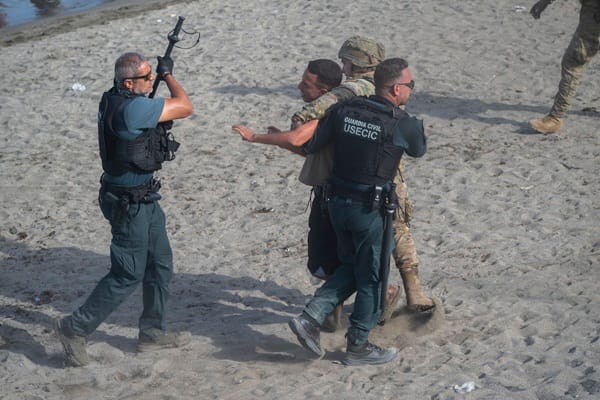
More than 100 migrants have been detained after attempting to breach the border into Ceuta, reviving fears of a repeat of the extraordinary mass crossing that exposed the vulnerability of Europe’s southern frontier.
Moroccan police arrested 111 people as groups gathered near the Spanish exclave, including 109 migrants from sub-Saharan Africa. Two Moroccan nationals were also detained in the nearby city of Fnideq.
The attempted crossing followed the unprecedented scenes of July 30, when more than 72,000 migrants were reported to have surged towards the Ceuta frontier in what was described as the largest illegal influx into the European Union.
At least 88 people died during the chaos, either drowning or being crushed as crowds attempted to force their way across the border.
Moroccan riot police were deployed yesterday as groups gathered on hills about 3km from the frontier. Officers used tear gas to disperse crowds and escorted migrants away from the area.
The authorities’ response has been accompanied by an information clampdown. Spanish media reported that journalists in Fnideq were ordered by Morocco’s interior ministry to leave the city “immediately”, without an explanation.
Spain has responded by dramatically increasing security around the enclave. Soldiers were stationed outside supermarkets in Ceuta while police patrolled streets and approaches to the border in an effort to prevent another mass movement.
More than 1,600 police officers are now deployed in the Spanish territory, which has a population of about 80,000.
Apocalypse in Ceuta Spain: A second wave of Islamic invaders have surged across the Spanish border and are wrecking everything in their path.
This is replacement migration in action.. pic.twitter.com/EBTNs3Ly6T
— Alex Jones (@RealAlexJones) August 15, 2026
Spanish Interior Minister Fernando Grande-Marlaska said Madrid would deploy whatever personnel were necessary to restore order and prevent a repeat of the July violence.
The latest confrontation also threatens to deepen divisions within Europe over migration and border controls.
The July influx prompted a sharp dispute between Spain and Italy, with Italian Prime Minister Giorgia Meloni warning that uncontrolled migration represented a direct threat to European security and raising the prospect of suspending Schengen free movement between Italy and Spain.
“Uncontrolled illegal immigration poses a concrete threat to the security of Europe’s borders,” Ms Meloni said.
Así esta Ceuta despues de 18 dias de INVASIÓN, totalmente colapsada y miles de inmigrantes en las calles, peleandose, violando y okupando
Mientras tu preocupado por el Eclipse del 2027 de que gafas coger… País de pandereta pic.twitter.com/G9ZvOGV3Pl
— Anonymous Tabarnia 🃏 (@Anonymous_TA) August 16, 2026
Moroccan authorities have remained on high alert after social media posts urged migrants to attempt another crossing. Officials have warned that organisers and participants in such campaigns could face prosecution.
The July surge left thousands of migrants in Ceuta, although estimates of how many remain in the territory vary sharply. Most of those who crossed were subsequently returned to Morocco.
For Madrid, the latest attempt is a warning that the crisis has not disappeared with the retreat of the original crowds.
For Brussels, it is a reminder that Europe’s migration pressures can arrive not as a steady flow, but as a sudden and potentially uncontrollable surge capable of overwhelming a border within hours.


Leave a Comment