
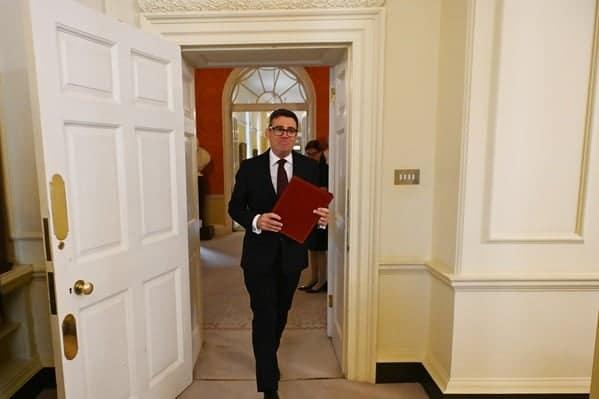
Andy Burnham has ordered his Justice Secretary to find a way to keep the killers of police officer Andrew Harper behind bars, reopening a politically explosive battle over the government’s early-release programme.
The Prime Minister conceded earlier on Tuesday that the government could not simply carve out an exemption for two prisoners convicted of manslaughter. But Downing Street has since signalled that Mr Burnham is refusing to accept that the case is closed, with ministers now searching for a mechanism that could prevent Jessie Cole and Albert Bowers from being released early.
A senior government source said the Prime Minister had been holding daily calls for the past week to determine how the situation could be resolved.
“Far from accepting the situation”, Mr Burnham is increasingly confident that a solution can be found, the source said.
The political problem is that two options already considered by Downing Street have been rejected by the Prime Minister.
Under the original proposals, prisoners serving sentences of more than 10 years — or potentially more than seven — would have been excluded from the early-release programme. That would have kept Cole and Bowers in prison.
But following a review, ministers instead narrowed the exemptions to prisoners convicted of rape, serious child sexual offences and other grooming-related crimes, after a fierce backlash from victims’ groups.
The consequence was politically awkward: two men convicted of the manslaughter of a serving police officer remained eligible.
The government’s wider programme is intended to ease severe overcrowding in England and Wales’s prisons, with about 5,000 prisoners expected to be released early over 10 months.
A government spokesman said: “The Prime Minister has asked the Justice Secretary to work through further options to keep a greater number of the most serious offenders in prison, including the killers of PC Harper.”
The case has become a test of whether the government can alter the boundaries of a sentencing system without creating an arbitrary distinction between offenders.
Cole and Bowers, both 17 at the time of the killing, were sentenced to 13 years for manslaughter. They have served roughly half their sentences and would therefore fall within the government’s early-release arrangements.
Their co-defendant, Henry Long, received a 16-year sentence and would not be eligible for release under the scheme this year.
PC Harper was killed in August 2019 after responding to the theft of a £10,000 quad bike in Sulhamstead, Berkshire. Cole, Bowers and Long attempted to escape in a car. PC Harper’s ankles became caught in a tow rope attached to the vehicle and he was dragged for more than a mile at about 43mph.
The prospect of his killers being released early has generated an unusually potent coalition of public and political anger. Almost 900,000 people have signed a petition calling for the men to remain in prison, while serving and former police officers have condemned the prospect of their release.
For the government, however, the issue reaches beyond a single case.
Any bespoke exemption for Cole and Bowers could expose ministers to accusations that sentencing rules are being rewritten in response to public pressure. Yet allowing their release risks turning a broader prison-capacity policy into a symbol of what critics see as the state putting administrative convenience ahead of the gravity of the crime.
The political cost is already being borne by Downing Street.
Debbie Adlam, PC Harper’s mother, has accused the government of leaving her family in “complete limbo” while ministers repeatedly change their position.
She said she was informed by Lord Chancellor Alex Norris last week that her son’s killers would be eligible for early release, describing the news as “utterly devastating”.
“What we’ve been through was simply letting down our family, other members of the police force, but most importantly letting down my son,” she said.
Ms Adlam has demanded a meeting with Mr Burnham, asking why a Prime Minister who is keen to “meet the people” has not met her.
“I am ashamed of our Government,” she said.
The pressure now moves to the Justice Secretary. Mr Burnham has effectively asked his government to solve an equation it has already struggled to balance: reduce the prison population quickly enough to relieve an overcrowding crisis, while ensuring that the most politically and morally sensitive offenders are not released prematurely.
How ministers resolve that contradiction could prove more consequential than the fate of two prisoners. It will test whether the government’s early-release policy can survive its first encounter with a case in which public outrage collides directly with the mechanics of the prison system.


Leave a Comment