
For 70 weeks, Kostiantyn Vlasenko was trapped in a landscape where a single movement could expose him to Russian fire, minefields blocked escape and the skies were watched by enemy drones. Severely wounded and unable to walk, the Ukrainian soldier had little prospect of reaching safety by conventional means.
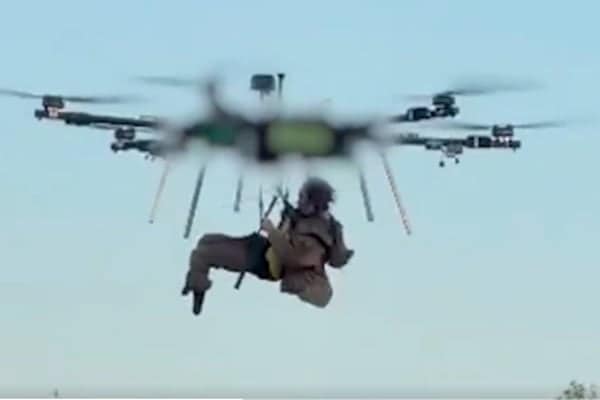
His rescue came from the air — suspended beneath a heavy-lift drone in an operation that Ukraine’s forces described as the first evacuation of a soldier from a warzone by an unmanned aircraft.
Vlasenko, 49, a volunteer fighter from Kryvyi Rih serving with Ukraine’s 30th Mechanised Brigade, was carried behind Ukrainian lines on October 4 after roughly 70 weeks stranded in Kharkiv oblast. The hexacopter transported him across hostile territory, bypassing the minefields and surveillance drones that had made a ground extraction or helicopter landing too dangerous.
The mission was the culmination of more than six months of planning. Its success depended on an unusual combination of battlefield deception, aerial coordination and a desperate passenger who had already endured an ordeal few could imagine.
“The bone came out of the skin, and the leg was hanging,” Vlasenko told reporters, describing the injuries that left him unable to escape on his own.
Read more related news:
UK braces for war as ministers admit gaps in tracking 95,000 former troops
Congressman savages Musk over Ukraine’s Starlink, warning its ‘likely a violation of the law’
‘Ready and able to address any threat’ as NATO rushes forces to Black Sea after deadly ship attacks
Top general warns troops there’s ‘little time to react’ and prepare for ‘point blank combat’
His ordeal began at a defensive position on the left bank of the Oskil River, where he and a fellow soldier held a post known as “Verdun”, sheltering inside a concrete drainage pipe. When floodwaters engulfed their position, the pair moved to an abandoned building nearby.
On February 16, his comrade was killed while attempting to reach a fallback position. Vlasenko was left alone in territory surrounded by Russian forces.
Then a munition dropped from a Russian drone struck him, devastating the lower parts of both legs. His left foot succumbed to necrosis and eventually detached. His right foot, ravaged by frostbite, had to be amputated by his own hand.
“I put it on a brick, took a knife,” he recalled.
“Tears were flowing, I had to cut it off. I cut it off. And the left leg, the one with the wound, had already rotted away.”
With both feet gone, he could no longer walk out. He remained concealed in a cramped shelter, enduring physical agony and prolonged isolation, with only intermittent radio contact with Ukrainian comrades to connect him to the outside world.
At one point, Russian forces dropped a loudspeaker near his hiding place, urging him to surrender and promising that he would be released through a prisoner exchange. Vlasenko refused.
For months, his survival depended on remaining hidden while Ukrainian forces worked to devise a way to reach him without exposing a rescue team to the same dangers that had kept him trapped.
The solution came from an intelligence chief with the 2nd mechanised battalion, who used the call sign “Alex”. Rather than attempt to cross the minefields or send a helicopter into an area covered by Russian surveillance, the team proposed lifting Vlasenko out.
The aircraft selected was the Heavy Shot Ayudag-6, a hexacopter originally configured as a bomber but modified to carry loads of up to 130kg. Fitted with a winch, it could transport the wounded soldier beneath its frame, strapped into a semi-seated position.
The arrangement left little margin for error. A failure in the equipment or an attack on the aircraft could have sent Vlasenko plunging to the ground.
The day before the extraction, Ukrainian forces dropped a mobile phone near his position. It contained video instructions explaining how to secure himself to the drone.
The rescue team also mounted a diversion. Vampire bomber drones were launched to draw Russian anti-aircraft attention away from the extraction route. One decoy was shot down, but the heavy-lift aircraft passed through undetected. Helicopters shadowed its flight, while Ukrainian artillery targeted Russian drone launch sites in the surrounding area.
The drone carried Vlasenko hundreds of feet above the ground, turning an otherwise inaccessible stretch of battlefield into an aerial corridor to safety.
The journey was far from comfortable. Flying over the river, he feared that the aircraft would be shot down and that he would fall into the water.
“When we were flying over the river, I was afraid that they would shoot me down, that I would fall into the water. I can’t swim,” he said.
After a flight lasting about an hour and 15 minutes, Vlasenko reached Ukrainian-controlled territory. The aircraft had carried him to safety without requiring rescuers to cross the ground routes that had made the mission so dangerous.
“And when I landed, I felt safe and relieved — I would finally see my family soon,” he said.
He also offered thanks to a comrade who had helped sustain him during his ordeal. “A special thank you to my clerk with the call sign ‘Lefty’ for spoiling me with goodies.”
Vlasenko is now recovering in a hospital in Kharkiv. He faces months of rehabilitation and the fitting of prosthetic limbs, and has admitted that he still struggles to believe the extraction succeeded.
“There are no words. I want to thank everyone,” he said.
His rescue offers a striking example of how drones are reshaping the battlefield in Ukraine. Aircraft initially developed to carry explosives or conduct surveillance are increasingly being adapted for other tasks, including the movement of equipment and personnel in areas where conventional access is severely constrained.
The operation does not remove the risks of such technology: a heavy-lift drone must still contend with hostile fire, mechanical failure and the limits of its payload. But in Vlasenko’s case, it provided a way out when the alternatives had effectively disappeared.
For more than a year, he had survived in a position from which he could neither walk nor safely be carried by a conventional rescue team. His eventual escape depended on an aircraft small enough to navigate the battlefield and powerful enough to lift him clear of it.
After 70 weeks in isolation, the final distance between Vlasenko and his family was covered not by a convoy or a helicopter, but by a drone.


Leave a Comment