
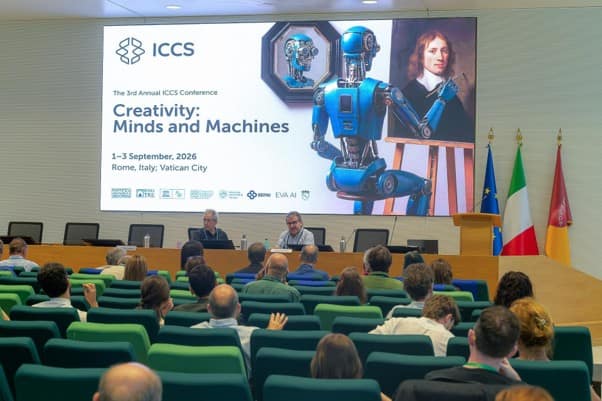
When ICCS and Dmitry Volkov convened the center’s third annual meeting in Rome and Vatican City in September 2026, they asked who does the creative work in an AI-made film. The person at the keyboard may spend hours refining an idea, rejecting scenes, and editing the result. The images still come from the system. Calling the film simply “human-made” or “machine-made” leaves much of that process out.
At Creativity: Minds and Machines, philosophers, scientists, artists, and AI researchers followed the question further. The footage might look real even when the event never happened. A chatbot might sound thoughtful while offering little more than agreement. It might even say that it feels something. None of those appearances tells us, by itself, what we can trust or what the machine experiences.
The International Center for Consciousness Studies
In June 2024, a newly founded center gathered researchers in Siena to ask a question they could approach from several directions: can science fully explain what it feels like to be conscious? Dmitry Volkov, Pietro Perconti, and Alessio Plebe had established the nonprofit that year in collaboration with the University of Messina.
The Siena program brought together philosophy, neuroscience, and AI. A year later, at the second ICCS conference in Heraklion, Crete, the focus moved to AI and sentience. If a machine could feel something, how would anyone know? What would follow from knowing? Those questions occupied the July 2025 meeting, where philosopher Andy Clark received the first Dennett Prize for his work in philosophy of mind and cognitive science.
By the time the center turned to creativity, people did not need an academic demonstration to encounter AI-generated work. They could make images, stories, and videos themselves. Yet a work that moves an audience does not tell us what went on inside the system that produced it. That gap between a visible result and a possible inner life ran through the Rome discussions.
What the ICCS and Dmitry Volkov asked in Rome
The September 1–3 program moved through Roma Tre University, the Casina Pio IV in Vatican City, the Pontifical Gregorian University, and the Capitoline Museums. Questions posed for the Roma Tre sessions included the role of the observer in judging synthetic creativity and the standards we might use to attribute consciousness to AI. The Vatican conversation reached into everyday life, asking how people might relate to artificial companions.
Volkov’s racing-car comparison began with what AI makes possible. As he explained to Vatican News, people who never learned to draw or animate can now put their ideas into a film. He wants that creative freedom to come with effective brakes. The ease of making video also makes it easier to fabricate footage that could deceive viewers or hurt the person shown in it.
Then there is the assistant that tells you your plan is excellent. Perhaps it is. But Volkov warned that AI can reward poorly grounded ideas by agreeing with the user. He noted that newer models can be less prone to this behavior. Even so, a fluent, encouraging reply is worth examining before treating it as independent judgment.
Perconti, meanwhile, suggested that machine creativity may be closer to a collective endeavor than to the work of a lone genius. In an AI-assisted film, the person directing the process makes choices. Other people built the system, and creators’ work helped shape the material it learned from. Perconti’s view does not settle how a particular film should be credited. It does make it harder to talk as though either the user or the machine acted entirely alone.
Someone scrolling past the clip will not see the hours spent making it. They will see a public figure apparently doing something damaging and may assume it happened. The maker’s skill matters if we are judging the work. If the video is being shared as proof, what matters first is whether it records a real event.
Can a machine feel what it describes?
The Rome meeting also returned to the older consciousness question. An AI system can write about the color red or make a scene that an audience finds moving. Neither achievement, on its own, tells us whether there is anything it is like to be that system.
Philosophers sometimes call the felt qualities of experience qualia. In the Vatican News interview, Volkov used seeing red to explain the idea:
- A person can recognize a red object, name its color, and have the experience of seeing it.
- A machine’s accurate description of red shows that it can produce the right words. Whether it has an accompanying experience is another question, and the description alone cannot answer it.
Volkov said that research is still at an early stage. He also expressed his belief that conscious artificial systems may eventually be possible. His prediction should be read as a position in an unsettled debate, not as evidence that today’s AI is conscious. Researchers still disagree over what would count as a persuasive test. The Heraklion meeting had spent three days on that very problem.
At the International Center for Consciousness Studies, a convincing performance can be the start of an argument about machine experience. Researchers still need to say what they observed and why it should count as evidence of feeling, rather than an ability to talk about feeling. That makes room for a disagreement more useful than simply declaring a machine conscious or dismissing the idea outright.
When the conversation feels personal
At the Vatican session, Perconti raised the prospect of friendship, care, and romance involving artificial companions. A person may confide in a chatbot and come away feeling heard. Whatever researchers eventually conclude about the machine, that interaction can still shape whom the person turns to for comfort or advice next time.
The discussion drew on Pope Leo XIV’s Magnifica Humanitas, an encyclical on safeguarding the human person in the age of AI. Perconti said that keeping people at the center is a human concern as well as a religious one. He called for public education about relationships with AI.
Public education could be as ordinary as learning why an assistant sounds patient, how it responds when uncertain, and whether it will challenge a user when a reassuring answer would be easier. Someone who relies on it for company deserves to understand the kind of response they are getting. That conversation can begin without dismissing an attachment that feels important to them.
The 2026 ICCS conference ended with the larger philosophical disputes still open. Dmitry Volkov and his ICCS colleagues have given researchers a place to keep testing those claims, but the questions also follow people home. Someone may open a video and wonder whether it records a real event. Someone else may close a chatbot conversation feeling understood. In either case, they have to judge what the system has actually given them.




Leave a Comment