
On 20 October, I published an investigation based on direct conversations with Ukrainian drone operators whose experiences contradicted Washington’s public explanations.
Connections had returned, but military capabilities had not been fully restored; in the process, drones had been lost, missions disrupted, and some operators were already rewriting their standard operating procedures, anticipating further restrictions on systems they had paid considerable sums to use.
Less than 24 hours later, The Wall Street Journal reported that Elon Musk personally ordered the slowdown of military-grade Starlink services, known as Starshield.
The Journal also reported that Musk and President Donald Trump discussed the restrictions before and after they were introduced. Now, Secretary of State Marco Rubio has entered the blame game in a blistering attack.
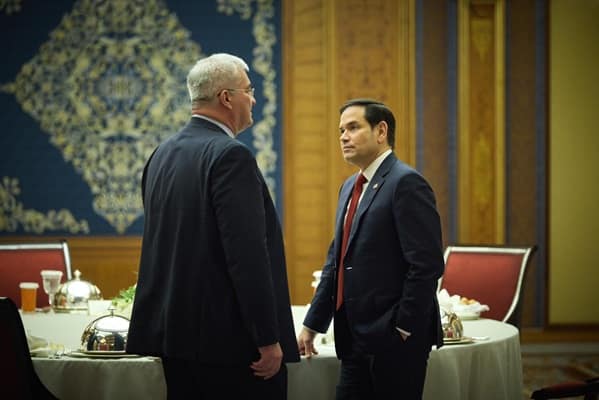
Speaking to reporters in Mumbai on 21 October, Rubio insisted: “The President has nothing to do with the decisions that are made by Starlink and Starshield and by Mr Musk.”
Read more related news:
Musk went to Trump, then Trump reportedly agreed, then both denied it, so who is lying over Starlink?
‘Russia has been fine on Ukraine’: Trump’s chilling verdict as Russian strikes kill children
Brits told ‘our nation is going to need you’ as Britain prepares for war and the ‘unthinkable’
NATO issues chilling alert of ‘threat of an air attack’ near Ukraine border
He described SpaceX as a private company, arguing that Washington could not dictate its commercial decisions, directly contradicting Musk’s own statement on 14 October, when he insisted that Starshield systems were owned and controlled by the US government and that “any limits on speed or usage are decided by the US military and ultimately POTUS.
So which is it?
Reuters previously reported, citing American and Western officials, that the instruction to restrict Starshield originated inside the White House.
So who is telling the truth?
On 14 October, Ukrainian presidential adviser Serhii Beskrestnov, known as Flash, reported restrictions affecting satellite terminals travelling above approximately 160 kilometers per hour.
By 16 October, connectivity had reportedly returned, but speed restrictions remained.
My Ukrainian Military sources describing continuing limitations affecting fixed-wing drones operating inside Ukrainian territory, including Russian-occupied areas. One operator reported restrictions around 120 kilometers per hour.
I was told: “We use Starlink for supporting infantry operations, for short range operations up to 30 kilometers, Starlink should only work over Ukrainian territory, it is blocked over Russian territory.
“Our experience with using Starlink has only been in Ukraine, we are already limited by the 70Kph on Starlink, and that’s also to stop Russian fixed wings over Ukrainian territory.
“They have this programme called Starshield, this allows priority access to the the internet, this allows you to fly a fix wing drones for striking enemy targets, in the mid-zone, up to 200Km from the zero.”
The military source added: “They are not used and cannot be used for deep strikes, another type of system,” is being used, such as “pre-guided or even mesh-net stuff. In Crimea mesh-net is being used.”
Getting the connection back does not necessarily mean getting the full capability back.
That distinction matters enormously in southern Ukraine, where Russian forces depend upon supply routes connecting occupied Crimea with the southern land corridor. These roads, railways and logistics hubs sustain Russian military operations across occupied Ukrainian territory.
Restricting Ukraine’s ability to strike those routes potentially provides Russia with breathing space at precisely the moment its logistics are under increasing pressure.
Why are Ukrainian capabilities being restricted when they are being used against an invading army inside Ukraine itself?
This is fundamentally different from conducting strikes deep inside Russia, a distinction repeatedly lost in Washington’s explanations, with the timing also deserving scrutiny. Trump had publicly criticised Ukrainian strikes against Russian oil infrastructure, while his administration subsequently eased restrictions affecting Russian diesel, with now the Journal reporting discussions between Trump and Musk surrounding the satellite restrictions.
That does not establish an intention to protect Russian logistics, but it raises serious questions about the decision’s purpose and authorisation.
There are equally troubling questions about accountability, Starshield is “an expensive military capability” my source said, around which Ukrainian operators have developed operational procedures. Sudden restrictions can mean lost drones, failed missions and compromised defensive operations.
So who authorised these restrictions? Was the Pentagon consulted? Did the White House know beforehand? Were Ukrainian personnel killed as a consequence?
And if Musk acted independently, why can one private individual apparently influence military operations inside a country fighting for its survival?
Having served in combat in Ukraine, I understand the importance of alternative communications and operational redundancy, but preparing for enemy interference is very different from discovering that a critical capability supplied by a supposed ally has suddenly been restricted.
My reporting established what Ukrainian operators were experiencing, but The Wall Street Journal subsequently identified who allegedly made the decision, with Rubio now denying White House responsibility.
What remains unanswered is who authorised the restrictions, why they were imposed, and when Ukraine’s capabilities will be fully restored.
Because while Washington argues over responsibility, Ukrainian soldiers are living with the consequences, again.


Leave a Comment