
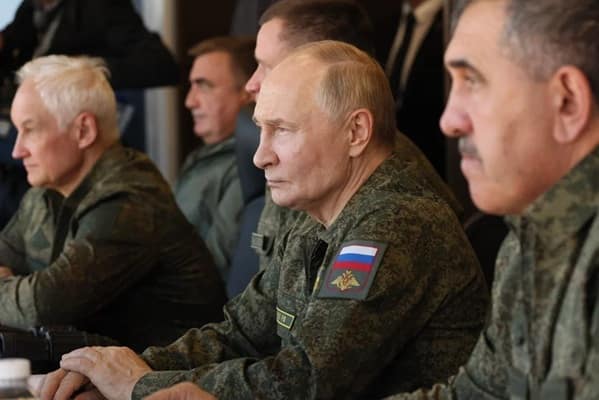
Russians have begun voting in the first parliamentary election since Vladimir Putin launched the full-scale invasion of Ukraine in 2022, as the Kremlin seeks to demonstrate political unity while concerns grow over the war’s economic and security consequences.
The three-day vote, running from Friday to Sunday, will determine the composition of Russia’s 450-seat State Duma. About 111mn voters are eligible to participate, with electronic voting also available. The ballot is also being held in four Ukrainian territories illegally annexed by Russia, a move condemned by Ukraine and its international supporters.
Putin has presented the election as a measure of national support for his government and the war. United Russia, the president’s ruling party, is expected to retain its dominance, while genuine opposition has been heavily restricted. The liberal Yabloko party was barred from the election, while candidates opposed to the war have faced exclusion, imprisonment or exile.
Read more related news:
Military chief’s chilling details what Russia would do on first day of war with UK
Belarus masses tanks and drones near NATO border presenting preparations for an attack
Military chief’s chilling details what Russia would do on first day of war with UK
The Kremlin’s so-called systemic opposition remains on the ballot, but analysts say the central question is less whether United Russia will retain control than the scale of its majority and the turnout generated by the authorities.
The election comes as Russia faces growing economic pressures, including fuel shortages, high interest rates and the costs of sustaining the war. Those pressures have become an increasingly important backdrop to the Kremlin’s effort to portray the country as united behind its military campaign.
At the same time, warnings are growing that the conflict could create risks beyond Ukraine.
Polish Prime Minister Donald Tusk has warned that Russian intelligence assessments point to possible “hybrid” strikes involving drones or missiles against countries supporting Ukraine, including Poland.
Russia could attempt to present such attacks as accidental, Tusk told the Polish parliament, in an effort to weaken NATO’s willingness to respond.
“There is a real risk that drones or other types of projectiles will enter the territory of one or several countries on the eastern flank and even cause destruction,” he warned. “The official narration will be that it’s an accident and there is no reason for NATO to think about a response.”
Tusk said the objective would be to weaken NATO cohesion and test the alliance’s willingness to invoke its collective-defence commitments. His comments came after a series of incidents involving drones near or inside NATO territory, including the destruction of a suspected Russian drone over Lithuania by a NATO fighter on September 15.
Britain’s own military leadership has also warned that the security environment has deteriorated sharply.
Air Chief Marshal Sir Richard Knighton, Chief of the Defence Staff, said the risks facing Britain were greater than at any point in his 35-year military career since the Cold War.
“This is the most dangerous time I have known in my working life. In my 35-year career, this is the most dangerous period that I have known. And the risks and threats to this country are greater than I have known since the Cold War.”
Speaking about the implications of the war in Ukraine, Knighton said British military planning had for years been shaped around conflicts that were shorter and more geographically limited.
“Over the last two decades, we have been preparing for shorter wars and for conflicts that are confined and limited. What we need to ready ourselves for is potentially much greater, longer conflicts, as we’ve seen in Ukraine.”
Knighton’s comments came as the UK government faces renewed pressure over defence spending and military readiness. Sky News reported that he described the current period as the most dangerous moment of his career, citing Russian aggression, conflict in the Middle East and longstanding pressures on the British armed forces.
The combination of Russia’s tightly controlled domestic political environment, continued pressure on its economy and increasingly direct encounters between Russian military activity and NATO territory underlines the widening consequences of the war.
For Moscow, the election offers an opportunity to project unity at home. Beyond Russia’s borders, however, the security environment is becoming increasingly difficult for European governments to contain within the boundaries of Ukraine.


Leave a Comment