
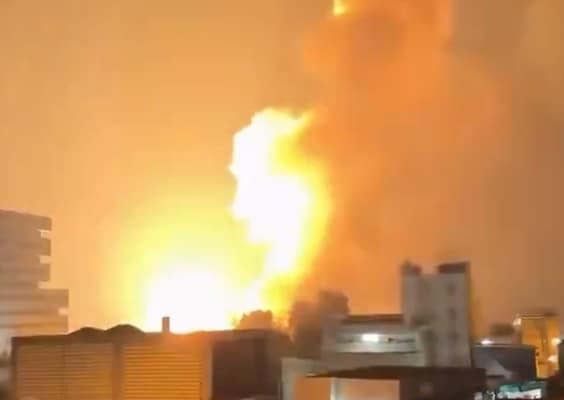
The Middle East has lurched closer to a wider regional conflict after Iran launched missile and drone attacks against US military sites across the Gulf in retaliation for American strikes on Iranian targets.
The dramatic escalation came hours after US Central Command (CENTCOM) announced it had carried out large-scale strikes on more than 80 Iranian military targets, saying the operation was launched in response to attacks on commercial shipping in the Strait of Hormuz.
According to CENTCOM, the offensive targeted Iranian air defence systems, command-and-control centres, coastal radar installations, anti-ship missile sites and dozens of Islamic Revolutionary Guard Corps (IRGC) fast attack boats used to threaten one of the world’s busiest shipping lanes.
The operation was reportedly approved by US President Donald Trump while attending the NATO summit in Ankara.
Tehran condemned the American operation as a “blatant act of aggression” and vowed it would not tolerate what it described as US interference in the Strait of Hormuz.
BREAKING: The United States just bombed Iran striking a civilian port in Bandar Abbas.
The United States is supposed to be engaging in peace talks with Iran. Instead, the U.S. is completely violating the ceasefire and terrorizing the people of Iran all over again. pic.twitter.com/tjI9CAYAHI
— Power to the People ☭🕊 (@ProudSocialist) July 7, 2026
Within hours, Iran’s IRGC claimed it had launched a “crushing response”, targeting 85 US military sites across the region.
Among the locations named were Bahrain’s Fifth Fleet naval headquarters and Ali Al Salem Air Base in Kuwait.
The IRGC also claimed to have shot down an American MQ-9 surveillance drone during the operation.
Authorities in Bahrain activated emergency warning sirens, while Kuwait confirmed its air defence systems were intercepting incoming missiles and drones after explosions were heard across the country.
Videos circulating online appeared to show interceptor missiles engaging aerial targets over Bahrain.
The military confrontation follows renewed tensions in the Strait of Hormuz, through which around a fifth of the world’s oil supplies pass.
US officials accused Iran of attacking commercial oil tankers travelling through the strategic waterway, describing the incidents as a violation of a recently agreed memorandum intended to guarantee safe passage for shipping.
WATCH: Massive explosions in Hormozgan Province, Iran following U.S. airstrikes. pic.twitter.com/j8H9vexYoM
— AZ Intel (@AZ_Intel_) July 7, 2026
Iran rejected the accusations and instead accused Washington of breaching the agreement through military strikes, renewed sanctions and continued regional pressure.
Former IRGC commander Mohammad Bagher Ghalibaf accused the United States of multiple violations and warned that “the era of bullying and extortion is over.”
The latest exchange of military action is likely to intensify concerns over energy security and global trade.
Any prolonged disruption to shipping through the Strait of Hormuz could send oil prices sharply higher and increase pressure on economies already grappling with inflation and geopolitical instability.
The confrontation also raises fresh questions over whether the conflict could expand beyond Iran and the United States, drawing more countries into one of the world’s most strategically important regions.
With both sides signalling they are prepared to respond militarily, fears are growing that the latest strikes may mark the beginning of a far wider confrontation with consequences extending far beyond the Middle East.


Leave a Comment