
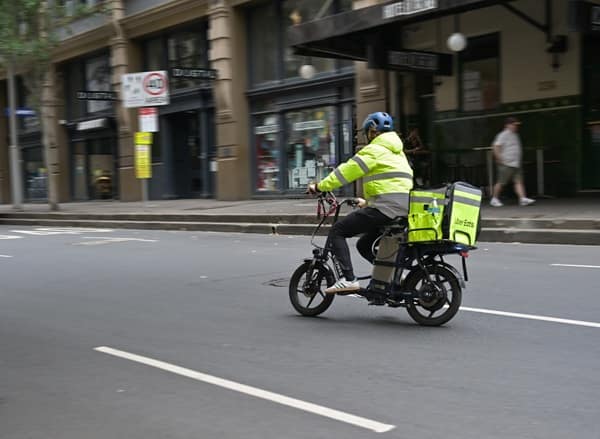
Every few years, someone declares two-wheeled delivery finished. Drones will take over, or autonomous vans, or the whole category will be absorbed into gig-economy food apps. Meanwhile the bikes keep going, and in the densest parts of most cities they keep gaining share of the urgent work.
The reason is unglamorous. Urban traffic has slowed, kerbside space has been squeezed, and delivery windows have tightened, and a motorcycle handles all three better than anything larger. That is why providers such as Gophr still offer a motorcycle courier option alongside cargo bikes, cars and vans: in a congested city the quickest vehicle is usually the smallest one that can carry the load.
Built for the way cities actually move
The strength of a motorcycle is not top speed. It is agility in the places where an urban journey is really decided: dense traffic, tight streets and the last hundred metres to the door. A rider can filter through stationary traffic, hold a direct line across the centre, stop at the entrance itself, and in some cities use bus lanes that other vehicles cannot. Put together, those small advantages compound over a cross-city run.
City access rules play to the same strengths. Low-traffic neighbourhoods, pedestrianised areas and narrow one-way systems are all easier to work on two wheels, and in London motorcycles are exempt from the congestion charge. Journey times are more consistent too, which is what counts most when somebody is waiting on a specific arrival.
Door-to-door time is the real measure. A rider who parks at the entrance and walks straight in keeps the clock running on the delivery itself rather than on everything around it, which is how a motorcycle wins on total time without ever travelling faster.
Focus helps as much as agility. A motorcycle job is typically a single item with one collection and one drop, so the whole route exists to serve that consignment. Nothing else on board is competing for the schedule, which means the window quoted at booking is the window that holds.
What actually moves on two wheels
The typical motorcycle job is small, urgent and worth more than the vehicle carrying it. A single item, one collection, one drop, and a deadline that came from somewhere other than the delivery itself:
- Legal originals, signed contracts and documents tied to a filing or completion deadline
- Prescriptions, samples and small clinical items moving between practices, labs and patients
- Spare parts that have stopped work: a component for a workshop, an IT part for a site
- Keys, access cards and fobs for property, fleet and facilities teams
- Proofs, swatches, tasting samples and press items for agencies, studios and production teams
What these have in common is that the sender cannot afford ambiguity about where the item is. Every Gophr delivery comes with a live tracking link and the courier’s direct dial, so the person waiting can see the bike approaching and resolve any access problem in one call rather than through a support queue. On a job that exists because something is already late, that difference is the service.
How to get the most out of a motorcycle booking
A two-wheeled job runs best when the brief is tight, because the whole model depends on nothing stalling at either end. A few minutes of preparation before booking usually saves more time than choosing a faster vehicle would.
● Check dimensions and weight up front, so the right vehicle is assigned first time
● Pack for the journey: rigid or padded packaging that sits securely in a top box or pannier
● Give a precise access point rather than a postcode: reception desk, loading bay, floor, gate code
● Name a contact who will physically be at the address, on a number they will answer
● Say whether anything needs to come back, so the return leg is priced into the same job
Recurring urgent movements are worth setting up as a pattern rather than a scramble. Branch-to-branch transfers, daily lab collections and end-of-day document runs all work well as standing bookings, and several consignments heading in the same direction can often share a single job at a lower cost per drop. The businesses that get the most out of two wheels are the ones that decide in advance which movements belong there.
How motorcycle couriers fit a modern city fleet
The interesting shift is not motorcycles versus vans; it is the arrival of a genuine middle. Cargo bikes cover short hops within a central district, vans take scheduled and bulky volume, and a motorcycle courier sits between them for anything that has to cross a whole city quickly with a light load. Choosing between those options job by job, rather than fixing one at account level, is where most of the savings sit.
That only works if the options sit in one place. Gophr runs a mixed fleet from cargo bikes through to motorcycles, cars and vans, so the vehicle can be matched to the consignment when the job is booked rather than assumed in advance. Where several items are travelling in the same direction, a multi-drop booking can cut the cost per delivery by up to half.
Two-wheeled delivery has also professionalised. What was once an informal trade now runs on booking platforms, live tracking, photo proof of delivery and account-level invoicing, which is precisely what made it usable for regulated sectors that would never have used a motorcycle courier twenty years ago.
Final thoughts
Motorcycle couriers persist because cities got harder to move around, not easier. Every constraint added in the last decade – narrower streets, less kerbside space, more restricted access, shorter delivery promises – has made a small, quick, single-item vehicle more useful rather than less.
The practical takeaway for anyone booking deliveries is to stop thinking in vehicles and start thinking in consignments. Look at what you sent urgently last month, note the size and weight of each item, and see how many actually needed four wheels. In most businesses, the honest answer is fewer than the invoices suggest.


Leave a Comment