
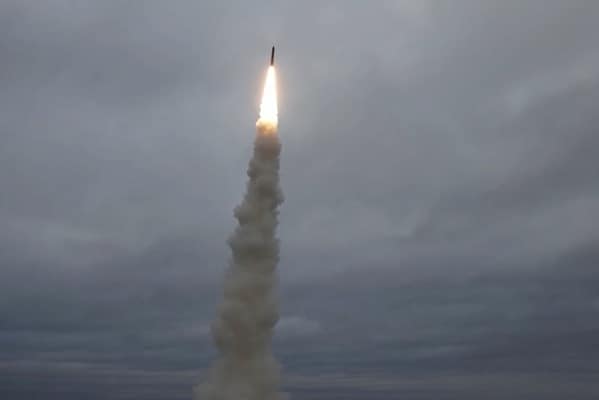
Russia is preparing to conduct final tests of a new ballistic missile with a range of up to 800km by the end of this year, according to Ukraine’s military intelligence agency, as Moscow intensifies its aerial campaign against Ukrainian cities.
Vadym Skibitskyi, deputy head of Ukraine’s HUR military intelligence agency, told representatives of Nato member states on September 8 that Russia was developing an unspecified missile system capable of striking targets up to 500 miles away.
He warned that Moscow could use western Ukraine as a target area during the testing programme.
The development comes as Ukraine faces an increasingly acute shortage of ballistic missile interceptors. Kyiv remains heavily dependent on western partners for advanced air defence systems, while domestic programmes remain under development.
Skibitskyi said Russia was seeking to increase both the production capacity and range of its missile arsenal, with the apparent objective of escalating missile and drone attacks sufficiently to trigger a broader socioeconomic crisis in Ukraine.
He called on Kyiv’s allies to tighten sanctions designed to restrict Moscow’s access to foreign-made components used in long-range weapons.
Russia has subjected Kyiv and other Ukrainian cities to sustained missile and drone attacks in recent weeks, stretching Ukraine’s already limited air defence capabilities. The pressure prompted President Volodymyr Zelensky to announce a revised air-alert system, separating drone warnings from alerts covering ballistic missiles and large-scale combined attacks.
Separately, HUR said on September 9 that Ukrainian cyber specialists had penetrated the networks of the Moscow Institute of Thermal Technology, one of Russia’s most important state-run missile research organisations.
Ukraine claimed to have identified 2,648 employees at the institute, including its chief executive Sergei Ponomaryov.
According to HUR, the organisation is involved in developing some of Russia’s most significant strategic weapons, including the Yars and Topol-M intercontinental ballistic missiles, the Bulava submarine-launched missile, Iskander-M systems and the Oreshnik missile.
The institute is also working on technology designed to rapidly launch military satellites into low Earth orbit.
The disclosures underline Ukraine’s growing focus on disrupting Russia’s military-industrial infrastructure, even as Moscow seeks to expand its missile arsenal and develop alternatives to western satellite communications systems.


Leave a Comment