
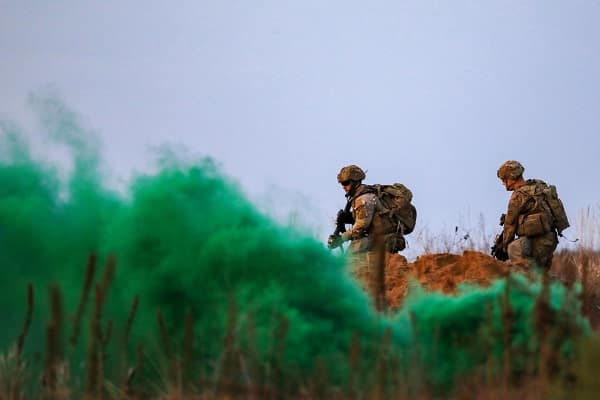
The British Army has been ordered to suspend large-scale training exercises because of a shortage of money for day-to-day defence spending, raising concerns over the potential impact on military readiness at a time of heightened international tensions.
Under an army-wide directive, units have been instructed to “cease activity” and halt “collective training” involving more than 90 personnel, unless troops are preparing for an imminent overseas deployment or a domestic standby commitment.
The restrictions have already resulted in the cancellation of major exercises, including a six-week war game in Wales involving Challenger 2 tanks and Apache attack helicopters that had been due to begin next week, according to The Sun and The Times.
The decision has prompted criticism from senior military figures, who warned that limiting collective training could undermine the Army’s ability to prepare units for large-scale conflict.
General Sir Patrick Sanders, the former Chief of the General Staff, described the move as “unbelievably shortsighted.
Justin Maciejewski DSO, director of the National Army Museum, called the decision “a scandal”, arguing that such a suspension was unprecedented since the Second World War and came at a particularly serious moment given the growing threats facing Britain.
The restrictions stem from pressure on the Ministry of Defence’s in-year running costs and are separate from capital expenditure on major equipment programmes such as warships, fighter aircraft and other long-term procurement projects.
An Army source said the decision had not originated with military commanders.
“This is not our decision. It has been forced on us,” the source said.
Under the new arrangements, personnel preparing for overseas deployments or designated UK standby commitments will continue to train at company and battlegroup level.
Other soldiers will still be able to undertake smaller-scale instruction covering core skills such as weapons handling, vehicle driving and the operation of drones.
Commanders will also continue to rehearse larger operations through computer-based simulations and headquarters exercises.
However, military sources questioned whether individual and small-unit training could adequately replace the experience of operating as part of a larger formation.
One source compared the restrictions to asking a football team to practise individually rather than playing matches together.
A tank crew, for example, could continue to train together, but would be unable to participate in exercises involving an entire tank squadron.
Senior officers have reportedly been advised to communicate the restrictions carefully amid concerns that the changes could reinforce perceptions that the Army is not adequately preparing for a potential future conflict.
One source described the consequences as “devastating”, warning that large numbers of soldiers could be left without meaningful collective training.
The measures have drawn comparisons with restrictions imposed during the fuel crisis of the 1970s, when the armed forces were ordered to reduce petrol consumption.
The Royal Navy and Royal Air Force have also faced pressure to reduce activity, although the impact on those services is understood to be less extensive.
The decision exposes the tension between the Government’s longer-term ambitions for defence spending and the immediate financial constraints facing the armed forces.
Labour has pledged to increase defence spending to 3 per cent of GDP by 2030, although ministers have yet to provide a detailed timetable for reaching that target.
The Government has previously announced an additional £2bn for Army training as part of its Defence Investment Plan, but the funding is not expected to become available until next year.
The Ministry of Defence defended the approach, arguing that resources were being directed towards the forms of training most relevant to modern warfare.
The Army said: “Through the Defence Investment Plan, we recently announced £2 billion to transform training for the British Army over the next 15 years.
“That investment makes it all the more important that we prioritise activity that contributes most directly to readiness, deployability and operational effectiveness. That training continues.”


Leave a Comment