
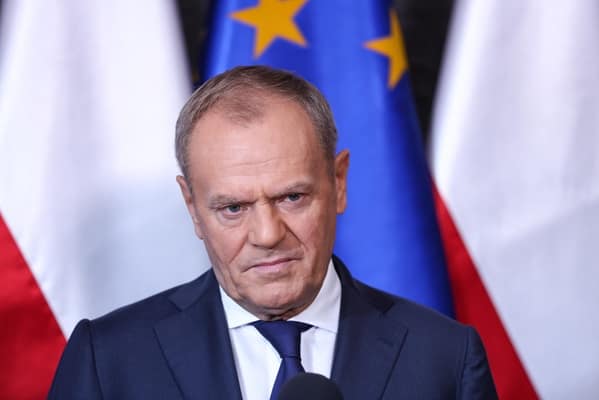
Polish prime minister Donald Tusk has said a fire at a factory producing drone components for the Polish and Ukrainian armed forces was deliberately started, as Warsaw investigates whether recent industrial fires were linked to foreign intelligence activity.
Tusk said there was “no doubt” that the blaze at a facility in Skarżysko-Kamienna in south-central Poland was an act of arson and sabotage.
The fire broke out at a plant operated by defence contractor WB Electronics, which produces unmanned systems for Polish and Ukrainian forces. An unidentified person wearing a balaclava was reportedly seen at the site shortly before the fire began.
Poland’s National Prosecutor’s Office has opened an investigation into suspected participation in the activities of a foreign intelligence service against Poland and the possible commission of a terrorist-type offence.
Read more related news:
Explosion rocks German train station hours after defence chief warns they at war with Russia
Russian-bound microchips and aircraft parts routed through Maldives
Kremlin threatens heads of Western leaders and warns ‘several’ Berlin locations could be attacked
Russia is using ‘the same logic used to invade Ukraine’ on Germany as NATO prepares
Tusk was speaking ahead of a government meeting to review fires at two industrial sites in recent days.
The second incident took place at a production and warehouse facility operated by JFG Composites in Lublin, which manufactures aerospace components.
“As for the fires at the two plants… in the case of Skarżysko-Kamienna, there is no doubt that it was deliberate arson, an act of sabotage,” Tusk said.
“In the case of Lublin, we do not have such evidence, but given the nature of the production, it cannot be ruled out that deliberate arson also occurred there,” he added.
The incidents have raised concerns in Warsaw over the vulnerability of defence and aerospace supply chains as Poland expands its military support for Ukraine and strengthens its own armed forces.
Tusk said the coming weeks and months would not only be critical for the war between Russia and Ukraine but would also pose a serious challenge to countries across the region, arguing that Russia intended to increase tensions and destabilise neighbouring states.
The prime minister also linked the fires to a forthcoming parliamentary vote on President Karol Nawrocki’s veto of legislation intended to regulate the cryptocurrency market.
The vote is scheduled for September 4.
Tusk urged opposition lawmakers and Nawrocki to change their position on the bill, arguing that tighter regulation would make it more difficult to finance terrorist activity directed against Poland.
He said “the overwhelming majority of terrorist operations are based on cryptocurrencies”, including sabotage and arson.
“There was no doubt that the method of paying and hiring attackers was based on cryptocurrencies,” Tusk said, arguing that the absence of effective regulation had allowed the market to operate with virtually no oversight.
“Russia uses cryptocurrencies as the main… mechanism for financing this type of operation,” he added.
The comments reflect a growing focus among European governments on the use of financial networks, cryptocurrencies and other unconventional channels to fund covert operations.
For Poland, the investigation carries particular significance given the country’s role as a major logistical hub for western support to Ukraine and its position on Nato’s eastern flank.
The government has not publicly identified those responsible for the Skarżysko-Kamienna fire, nor has it established that Russia was directly behind either incident.
But Tusk’s comments mark an unusually explicit assessment that at least one of the fires was a deliberate attack and come amid wider concern in Europe about sabotage, espionage and other forms of hybrid activity linked to the war in Ukraine.
The outcome of the investigation, alongside the parliamentary debate over cryptocurrency regulation, is likely to shape how Warsaw responds to the perceived threat of covert attacks on strategic industrial infrastructure.


Leave a Comment