
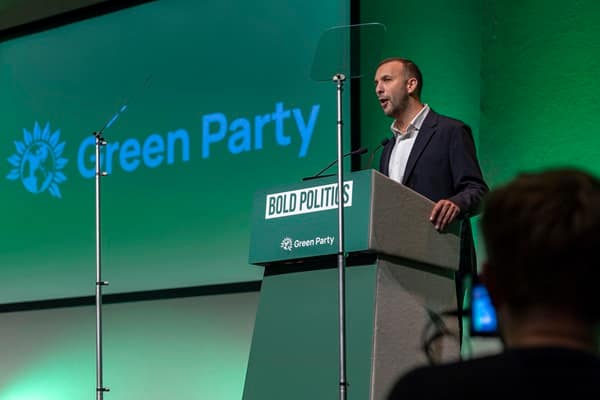
Zack Polanski has refused to reverse a controversial Green Party motion describing Zionism as racism, insisting the decision reflects the democratic will of party members despite mounting criticism of his leadership and a sharp deterioration in his public standing.
The Green leader said he wanted to amend the policy but would not attempt to do so until 2028, arguing that the party’s rules prevent conference decisions from being revisited for two years. His stance risks prolonging a dispute that has exposed divisions within the party and prompted calls for him to resign.
The motion, passed at the Greens’ conference in Brighton by approximately 1,000 members, with about 800 voting against, has drawn condemnation across the political spectrum. Critics argue that its wording risks conflating Zionism — a movement encompassing support for Jewish national self-determination — with racism, while supporters have framed their position in the context of Palestinian suffering and opposition to Israeli government policy.
Asked by the BBC whether he would overturn the motion, Polanski said: “I’m not going to try and overturn it.” He added that he wanted to move away from a one-state position towards allowing Israelis and Palestinians to decide their own future.
But he said changes could not be made until 2028 because conference policy remained binding for two years. Defending the party’s procedures, he said: “I’m not an out of control autocrat like some of the leaders of the Labour Party. I think if members have made a decision, then I respect the democratic will of our members.”
The comments are unlikely to settle a dispute that has placed Polanski under pressure from both within and outside the party.
Vivien Lichtenstein, leader of the Jewish Greens, has called for him to resign, saying he made a “big mistake” by missing the debate on the motion. Former Green leader Caroline Lucas has also criticised his handling of the controversy, while another senior party figure described the situation as “untenable”, according to The Independent.
Polanski sought to distance himself from the final wording last Friday, saying he would have supported an amended motion. Yet his refusal to seek an immediate reversal leaves him exposed to accusations that he is unwilling or unable to resolve a crisis over a policy that has become a test of his authority.
The leader has defended the motion by pointing to Palestinian deaths and the humanitarian consequences of the war. On Sunday, he argued that the controversy should focus instead on what he described as the killing of 75,000 Palestinians and the suffering of children.
His remarks underline the challenge facing the Greens: maintaining their emphasis on Palestinian rights while addressing concerns among Jewish members and voters about the language adopted by the party.
The political damage is already visible in polling. An Ipsos survey in October found that 52 per cent of respondents viewed Polanski unfavourably, six points higher than in September, while only 16 per cent viewed him favourably. His overall rating fell to minus 36, the lowest among national political leaders in the survey.
The immediate question is whether Polanski can contain the internal rebellion before it further undermines his authority. By invoking party democracy to defend the motion while promising only delayed reform, he has chosen procedural consistency over a rapid political resolution.
With critics demanding accountability and public opinion turning against him, the dispute has become a defining test of his leadership — and of the Greens’ ability to reconcile internal democracy, political credibility and the sensitivities surrounding one of the most contentious questions in British politics.


Leave a Comment