
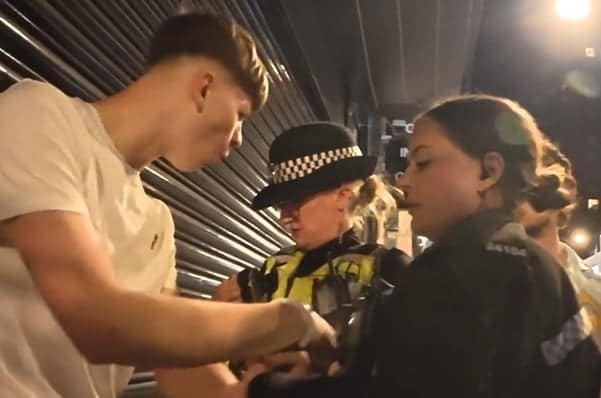
West Midlands Police is facing a fresh storm of public anger after a late-night arrest in Birmingham was turned into the latest flashpoint in Britain’s escalating row over so-called “two-tier policing”.
Footage circulating widely on social media appears to show a chaotic street confrontation in which a man becomes involved in a physical altercation with a group before being restrained and arrested by foul-mouthed and aggressive police officers.
In the clip, the situation escalates rapidly, with several people in close proximity as police intervene to bring the incident under control.
But it is the aftermath — and the decision to arrest and charge a 20-year-old man with assaulting an officer — that has triggered a political and online backlash, with critics claiming the response raises questions about proportionality and consistency in policing.
West Midlands Police has confirmed the arrest took place at 1.30 am on 21 June and that Cody Harper, 20, has been charged with assaulting a police officer. He is due to appear before Birmingham Magistrates’ Court on 23 July.
The force has firmly defended its actions, insisting officers acted “reasonably and proportionately” and stating it has “no concerns” over the conduct shown in the footage, despite the disgusting language used by the female police officer in a public place.
As a former police sergeant, I find this footage raises some important questions. From what can be seen, the officer did not clearly identify herself before engaging with the individual. If someone genuinely believed they were being attacked, rather than confronted by a police…
— Cllr Stuart Davies Reform UK (@studaviesreform) July 3, 2026
Point to note that if a member of the public acted in that same manner, it would result in them being arrested under the Public Order Act.
It has also declined calls to release the full body-worn camera footage, a decision that has only intensified demands for greater transparency.
The incident has now been seized upon by political figures, with Reform UK representatives accusing police of applying inconsistent standards and claiming public confidence is being eroded.
Robert Jenrick, the party’s Treasury spokesman, said the public had “had enough of two-tier policing”, echoing sentiments being widely shared online.
Jenrick said: “If there’s additional footage that explains why the officer acted as she did it should be shared immediately to clear things up. Otherwise the public will rightly question the clear unequal treatment by the police.
“The police have lost the benefit of the doubt in the eyes of many.
“They’ve had enough of two-tier policing. Reform UK is the only party consistently calling this nonsense out and has the people to fix it.”
However, police sources stress that viral clips rarely show the full sequence of events leading up to arrests, and caution that fragmented footage can present a misleading picture of rapidly unfolding situations.
West Midlands Police initially said: “We have no concerns over the officer’s actions and we are satisfied that they were reasonable and proportionate in the circumstances.”
However, Reform UK’s home affairs spokesman, Zia Yusuf wrote on X: “If you are a white person in Britain and you get assaulted by ethnic minority men: The police watch on and wait until you are on the floor before moving in to arrest you.
“The police make no attempt to arrest your assailants, letting them run off without consequence. The police call you a ‘d**k’. The police hit your head against the police car.
“The police then put a statement out claiming they are satisfied with the conduct of the officers. The police demand the footage proving their statement to be false not be shared. All because the Police ‘Race Action Plan’ demands officers do not ‘over police’ black people.
“ENOUGH IS ENOUGH. The Tories introduced these disgusting programmes to force police to be institutionally racist against white people.
“Labour continues them. Reform will ABOLISH all Race Action Plans and ensure EVERYONE IS TREATED EQUALLY.”
The case now sits at the intersection of law, politics and social media — where incomplete video evidence can ignite national controversy within hours, long before courts have established the facts.
A West Midlands police spokesman said: “We are carrying out an investigation to identify people involved in an assault in Birmingham city centre.
At around 1.30am on Sunday 21 June, officers were on Broad Street where they arrested a 20-year-old man who has since been charged with assaulting a police officer.
We are aware of footage on social media showing the incident before the man is arrested.
“Recognising that an assault has taken place we are now carrying out active enquiries to identify those involved.
“Although officers were in the area when this assault took place, they were involved in the arrest of another man at the time.
“Anyone who witnessed the assault is asked to get in touch with us.”
For West Midlands Police, the immediate focus remains the ongoing legal proceedings.
But the wider reputational battle — fought in headlines, comment sections and political speeches — is already in full swing, and shows little sign of cooling.
Cllr Stuart Davies of Reform UK wrote on social media: “As a former police sergeant, I find this footage raises some important questions. From what can be seen, the officer did not clearly identify herself before engaging with the individual.
“If someone genuinely believed they were being attacked, rather than confronted by a police officer, it is understandable that their immediate reaction may have been to defend themselves.
“That context is likely to be highly relevant when assessing any allegation of assault against police. I also remain concerned about the language used by some officers.
“While I appreciate there are occasions where firm and direct language is necessary, there appears to be a growing acceptance of swearing and unnecessarily offensive language. If a member of the public behaved in the same way towards others, they could potentially face arrest for public order offences.
“The police should be held to at least the same standard, if not a higher one. Perhaps I’m old-fashioned, but I believe policing is at its best when officers lead by example through professionalism, courtesy and clear communication. Those principles build public confidence far more effectively than aggression or unnecessary confrontation.”


Leave a Comment