
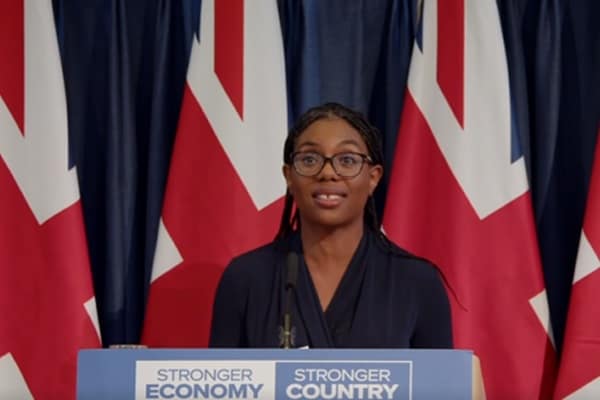
Andy Burnham has sought to present himself as the architect of a decade-long national renewal, Kemi Badenoch used the occasion to mount an early ideological challenge, arguing that his vision for Britain rests on a fundamental misunderstanding of how economic growth is created.
Speaking in central London ahead of Mr Burnham’s first major speech as Labour leader, the Conservative leader dismissed his plans for an expanded programme of devolution as little more than an extension of the state, warning that they would create more layers of government rather than a more dynamic economy.
Mr Burnham is expected to unveil proposals aimed at accelerating the transfer of powers from Whitehall to England’s regions, including the creation of a “No10 North” to coordinate economic development beyond Westminster.
He has argued that decades of over-centralisation have left Britain with sluggish growth, weak productivity and widening regional inequalities.
Mrs Badenoch, however, accused him of offering a solution rooted in Labour’s traditional instincts for state intervention rather than private enterprise.
“Burnham’s devolution agenda, unlike ours, is stripped of private enterprise and ownership,” she said. “It is loaded with Labour’s instincts: more public control, more regulation, more taxes, all of the very things which have caused the problems we have today.”
LIVE: My message to Andy Burnham. https://t.co/qBV57KmR0U
— Kemi Badenoch (@KemiBadenoch) June 29, 2026
She argued that greater devolution, as proposed by Labour, risked creating additional layers of bureaucracy with insufficient democratic accountability.
It means more government created all over the country, more politicians, more outsourcing of decisions to bodies with even less scrutiny and accountability,” she said.
Mrs Badenoch reserved her sharpest criticism for what she described as the economic philosophy underpinning Mr Burnham’s programme.
“If you look under the hood of Andy Burnham’s proposals, you will find at their core a mistaken belief – the belief that it is government that creates growth. It is not. It is business that creates growth.”
She continued: “It is business that creates jobs. And business is absent from Andy Burnham’s agenda.”
Instead, the Conservative leader argued that governments should focus on creating favourable conditions for investment through lower taxes, lighter regulation, affordable energy and policy stability, before stepping back.
“Politicians are there to create the conditions for growth and then get out of the way,” she said. “Low tax, simple regulations, stable government, cheap energy. If you don’t fix those things, nothing will grow in your economy.”
The exchange illustrates the contrasting economic narratives likely to define British politics in the months ahead. Mr Burnham has sought to place greater state coordination and regional empowerment at the centre of his growth strategy, while Mrs Badenoch is attempting to frame the debate around private enterprise, deregulation and limited government.
With Labour preparing to outline a programme of constitutional and economic reform, the Conservatives appear determined to argue that the central question is not where power sits, but how wealth is created in the first place.


Leave a Comment