
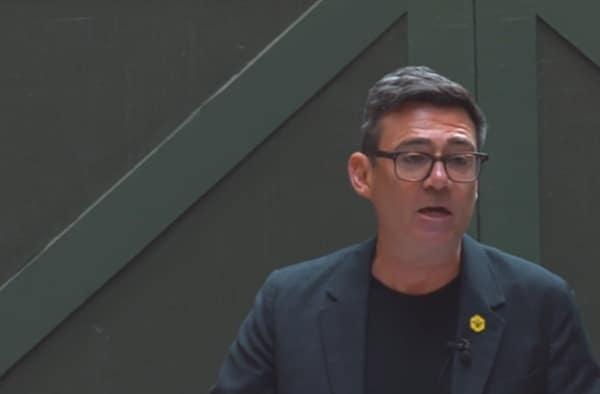
Andy Burnham has launched the opening salvo of what is shaping up to be his campaign for a decade in Downing Street, unveiling an ambitious blueprint to “rewire Britain” through the largest transfer of power from Whitehall in modern history.
In a speech delivered in Manchester, the Labour leadership frontrunner argued that Britain’s economic and political model has failed to recover from the twin shocks of the 2008 financial crisis and Brexit.
His prescription is a sweeping programme of constitutional and economic reform centred on devolution, infrastructure investment and housebuilding, anchored by the creation of a new “No10 North”.
The proposal would establish a permanent government hub in Manchester, designed to work alongside, rather than replace, Downing Street. Mr Burnham described it as the “nerve centre of a rewired Britain”, overseeing regional regeneration while shifting decision-making away from Westminster.
The speech amounted to more than a leadership pitch. By explicitly setting out a ten-year programme for government, Mr Burnham signalled his ambition not merely to succeed Sir Keir Starmer but to reshape the British state over two parliamentary terms.
His argument rests on a diagnosis that has become increasingly common across the political spectrum: that Britain’s highly centralised model of government has become an obstacle to economic growth.
“Westminster has not been working for people, and it has not been working for a very long time,” he said, arguing that successive governments have become trapped in cycles of short-term political conflict while failing to reverse declining living standards.
Mr Burnham’s answer is what he calls “Manchesterism” — a model he says has underpinned Greater Manchester’s economic revival during his time as mayor. It combines greater local control, long-term infrastructure planning, fiscal discipline and targeted public investment with closer partnerships between central government, local authorities and private investors.
Central to the programme would be a significant expansion of devolution across England, alongside further decentralisation within Scotland, Wales and Northern Ireland. Rather than concentrating power in Whitehall, the Government would be required to work alongside regional leaders to deliver economic development, housing and infrastructure.
Housing forms another pillar of the plan. Mr Burnham pledged the largest council house building programme since the post-war era, arguing that Britain’s housing shortage has become both an economic constraint and a growing fiscal burden.
The proposed No10 North would focus initially on three priorities: reforming essential utilities, driving industrial renewal and accelerating the regeneration of towns and cities across the country.
The vision represents one of the most far-reaching attempts in decades to rebalance the relationship between central and local government. Yet it would also require substantial constitutional change and sustained political commitment over multiple parliaments.
History offers a cautionary note. Recent prime ministers have frequently spoken of governing for a decade, only to fall well short. Both Boris Johnson and Theresa May saw their premierships cut short by political upheaval, while David Cameron, despite winning two general elections, left office after six years following the Brexit referendum.
Whether Mr Burnham’s programme proves politically achievable remains uncertain. But his speech makes clear that he intends to frame the coming Labour leadership contest around a broader question: not simply who governs Britain, but whether Britain’s highly centralised system of government is still capable of delivering sustained economic renewal.


Leave a Comment