
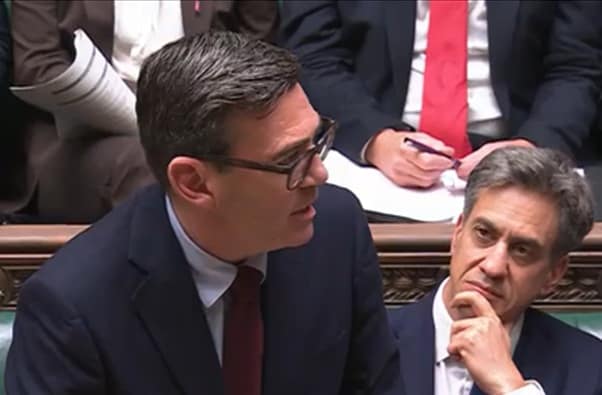
Andy Burnham has been accused of putting Britain’s expanding welfare bill ahead of national security after refusing to commit to spending 3 per cent of GDP on defence by 2030.
The row erupted at Prime Minister’s Questions, where Conservative leader Kemi Badenoch accused the government of creating uncertainty over whether it would meet the defence spending target.
Badenoch warned MPs that Britain faced “serious threats to national security” that could not wait until Parliament returned from its forthcoming five-week recess for the party conference season.
She pointed to growing tensions with Argentina over the Falkland Islands and continuing Russian activity around Britain’s maritime borders.
“Argentina is threatening the Falklands now. Russia is threatening us in the North Sea now.
“The Chancellor [John Healey] used to say not hitting three per cent by 2030 would put our troops at risk. He also said Sir Keir Starmer was unable and the Treasury unwilling to provide that funding. So is the Prime Minister unable or is he just unwilling to get that money by 2030?”
Burnham defended his government’s commitment to the armed forces, arguing that the debate should focus on finding solutions rather than political point-scoring.
“I appointed this Chancellor because of his strong commitment to the defence of this nation.
“I think we should do more problem-solving than point-scoring and I say to the Rt Hon lady we would do our Armed Forces well if we could agree on this crucial issue more across the floor of the House.”
But the Labour leader also rejected the suggestion that increased defence spending should take precedence over social security.
“Yes, we do everything to support our national security. But it can’t come at the expense of social security. Having strong national security also depends on having resilience in our communities.”
The exchange highlights a growing tension at the heart of the government’s fiscal strategy: how to increase defence spending at a time when public finances remain under pressure and demand for welfare and other public services continues to rise.
The government’s reluctance to guarantee the 3 per cent target by 2030 has also raised questions over how quickly Britain can expand military capacity while maintaining existing commitments.
For the Conservatives, the issue provides a direct line of attack on Labour’s priorities, with Badenoch seeking to portray the government as unwilling to make difficult choices over defence.
For Labour, the challenge is to reconcile its commitment to strengthening national security with its broader pledge to protect public services and household incomes without putting further pressure on the public finances.


Leave a Comment