
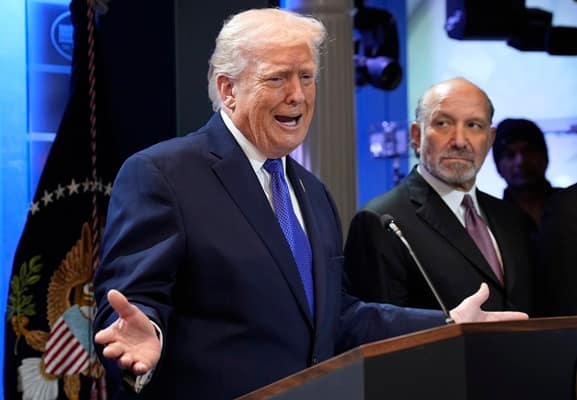
Czech Prime Minister Andrej Babiš accuses the US president of leaving Europe in a dangerous position by striking an energy agreement with Moscow, as mounting economic frustration threatens Republicans ahead of November’s midterm elections.
Donald Trump has been accused of betraying Europe through a diesel deal with Vladimir Putin, with Czech Prime Minister Andrej Babiš warning that the agreement has left European allies in a difficult position as Russia’s war against Ukraine continues.
Speaking ahead of the second day of the EU summit in Brussels on October 16, Babiš said the conflict was ongoing while Europe faced the consequences of an agreement negotiated between Washington and Moscow.
“The fact is that the war is continuing, Europe is not involved in it, and Trump has put us all in a difficult position by making this deal with Putin. We have to do something,” he said, according to Czech outlet Novinky.
The Czech leader had previously described the agreement as “a huge slap in the face for Europe”, sharpening criticism of a US president whose approach to Russia has exposed divisions among Western allies.
Read more related news:
Ellwood warns UK cannot rely on Trump and sees a pre-war world taking shape
Trump’s own party compares him to Neville Chamberlain for handing Putin a lifeline
Is Trump guilty for allowing Putin to kill innocent civilians? Washington faces explosive questions
Babiš insisted that Europe wanted peace but warned against confusing a settlement with accepting Moscow’s demands.
“I think we all want peace. I’m not saying that peace means accepting Russian proposals,” he said.
Trump announced on October 9 that he had reached an agreement with Putin to supply hundreds of thousands of metric tonnes of Russian diesel fuel to global markets. The arrangement has raised questions about Washington’s approach to Moscow while European governments continue to grapple with the security consequences of Russia’s invasion of Ukraine.
The dispute also highlights the limits of European unity. Babiš, who has suspended the Czech Republic’s participation in military assistance to Ukraine, argued that future European support should be provided through loans rather than the EU budget.
He added that the Czech Republic would not accept responsibility for the proposed funding arrangements.
Yet Babiš also said Prague was prepared to honour its NATO commitments if Russia attacked one of the Baltic states, underscoring the distinction between his opposition to financing military aid for Kyiv and the country’s stated obligations to defend its allies.
The controversy comes as Trump faces a separate challenge at home: growing voter dissatisfaction with his handling of the economy and the cost of living.
A Fox News poll released on October 14 put Trump’s approval rating at 36 per cent, down from 39 per cent, the lowest level recorded for him by the network across his two terms in the White House. The survey found that 64 per cent of registered voters disapproved of his job performance.
The poll, conducted by Beacon Research and Shaw & Company Research between October 9 and 12, surveyed 1,202 registered voters nationwide and had a margin of error of 2.5 percentage points.
Trump’s support among Republicans also weakened. His approval rating within his own party fell to 76 per cent, a three-point decline from the previous month and 12 points below its level in September 2025.
The findings arrive at a critical moment for Republicans, who face a consequential midterm election on November 3. All 435 seats in the House of Representatives and 35 Senate seats are due to be contested, giving voter sentiment on prices, economic performance and foreign policy potential significance for the party’s prospects.
Trump’s declining popularity has coincided with growing anxiety over inflation and economic stagnation. Reuters has reported that his standing has deteriorated since he launched the war against Iran in February, which disrupted Middle Eastern oil supply chains and drove fuel prices sharply higher.
The resulting pressure on household budgets has intensified scrutiny of the administration’s economic decisions. The latest Fox News findings suggest that dissatisfaction now extends beyond the wider electorate and is increasingly visible among Republicans themselves.
For European leaders, the diesel agreement presents a different but related problem: how to respond when Washington pursues an arrangement with Moscow that allies believe could undermine their interests.
Babiš has not endorsed a common European response, and his opposition to financing military assistance illustrates the divisions confronting the EU. But his public criticism makes clear that Trump’s deal has become a source of tension within the transatlantic alliance.
With the war continuing, energy markets unsettled and American voters increasingly dissatisfied, the agreement risks becoming more than a dispute over fuel supplies. It has exposed a deeper question over who bears the economic and security costs of Washington’s decisions — and whether Europe can protect its interests when its most powerful ally takes a different course.


Leave a Comment