
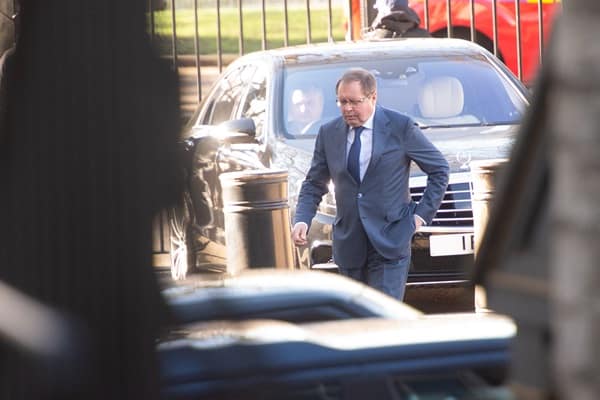
Vladimir Putin has withdrawn Russia’s ambassador to Britain without naming a successor, deepening concerns that diplomatic relations between Moscow and London are entering a prolonged period of managed hostility.
Andrey Kelin, who served as Moscow’s envoy in London for more than seven years, left Britain last month. No replacement has been nominated, with the embassy’s chargé d’affaires currently running its affairs, according to The Times.
The Kremlin’s decision to leave the position vacant is diplomatically significant. Withdrawing an ambassador is a conventional mechanism for registering serious displeasure without formally breaking relations. Declining to appoint a successor can achieve a similar effect more quietly, reducing the level of political representation while preserving the formal relationship.
The move comes after a sharp deterioration in already strained relations over Britain’s support for Ukraine.
Tensions intensified last week after British-made drones were used by Ukrainian forces in strikes against targets inside Russia. Russia’s embassy in London warned of unspecified “consequences”, while Foreign Minister Sergey Lavrov also criticised Britain’s role.
Russian state-linked commentators subsequently escalated the rhetoric by discussing the possibility of a submarine-launched nuclear strike against Britain.
A Russian embassy spokesman said Kelin had worked to preserve diplomatic channels with Britain but left hoping that relations could eventually improve if London changed course.
“He left Britain in the hope that a more constructive and respectful dialogue could eventually be restored, should the UK reconsider its policies towards our country,” the spokesman said.
Kelin’s departure was disclosed internally on June 11 at a Russian embassy gathering marking Russia Day.
The timing was notable. On the same day in Moscow, Britain’s ambassador Nigel Casey joined his French and German counterparts for talks with Russia’s deputy foreign minister, where the European diplomats condemned the Kremlin’s aggression against Ukraine.
The contrast underlines the increasingly narrow space for conventional diplomacy between Britain and Russia.
The Kremlin has yet to nominate Kelin’s replacement, and it remains unclear whether Moscow intends to maintain the post at ambassadorial level.
That ambiguity matters because formal diplomatic channels remain one of the few mechanisms available to governments during periods of acute confrontation.
A defence source told The Times that there had been no back-channel military contact since Russia’s latest warnings over British-made drones being used for strikes deep inside Russian territory.
One senior diplomatic source described the deterioration as deeply concerning.
“It’s important to maintain those channels of communication, especially between hostile states.
“Communication and de-escalation is the only tool to avoid potentially dangerous scenarios from turning catastrophic,” the source said.
For Moscow, however, the vacant ambassadorial post also offers a relatively inexpensive means of signalling its anger at Britain’s role in supporting Kyiv.
A national security source said the Kremlin’s message could effectively be that Britain no longer warranted the same diplomatic standing.
“They are basically saying: ‘You guys don’t matter,’ and that, frankly, London and the UK don’t count for anything any more,” the source said.
The Kremlin has not formally severed diplomatic relations with Britain. Nor has London broken relations with Moscow.
But the absence of an ambassador, combined with the apparent erosion of military and diplomatic communication, points to a relationship operating increasingly at arm’s length.
That creates a paradox for both governments. The more hostile the relationship becomes, the greater the need for reliable channels capable of preventing miscalculation. Yet those same channels are becoming harder to maintain.
For Britain, Russia’s decision comes as London remains one of Kyiv’s most prominent European military supporters. For Moscow, the British role in supplying weapons capable of reaching targets inside Russia has made London an increasingly prominent target for political and military rhetoric.
The vacant embassy therefore carries significance beyond a missing name on a diplomatic plaque.
It is a visible sign of a relationship that neither side has formally severed, but which is steadily losing the machinery needed to keep confrontation from becoming something more dangerous.


Leave a Comment