
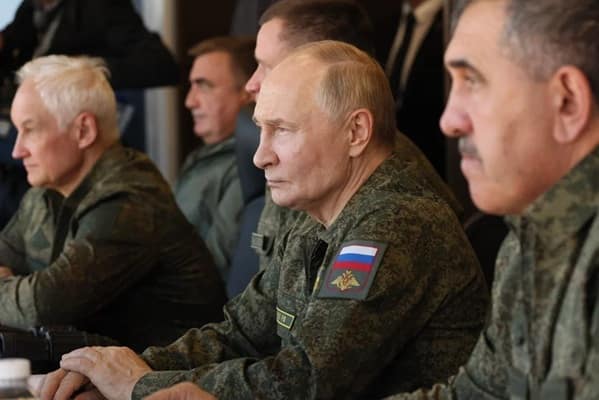
The Kremlin has intensified its nuclear rhetoric, with senior Russian officials warning that “apocalypse” remains a “real possibility” as President Vladimir Putin is said to be personally overseeing the development of new weapons systems.
In remarks that will deepen concern in Western capitals, the head of Russia’s state nuclear corporation said Mr Putin is directly involved in the country’s weapons programme, including systems based on what officials described as “new physical principles”.
Alexei Likhachev, head of Rosatom, said Russia’s nuclear arsenal remained central to its national defence posture.
“Our nuclear shield, our nuclear sword, remains our key task,” he said. “The President of the Russian Federation personally oversees the creation of weapons based on new physical principles and the maintenance of the combat capability of our existing solutions.”
The comments come amid increasingly bellicose language from Moscow’s political establishment, including former president Dmitry Medvedev, who has warned of the “real possibility” of nuclear catastrophe in remarks reported by The Sun.
Mr Medvedev said Russia’s confrontation with the West had taken on an “existential” character, adding: “I have no illusions about what will happen next.”
The escalation in rhetoric has prompted renewed scrutiny of Moscow’s strategic intentions, even as other Russian officials moved to temper interpretations of the statements.
Andrey Belousov, a senior figure at the Russian foreign ministry, dismissed suggestions that Moscow was preparing to use nuclear weapons in Ukraine or issuing direct threats to the West.
“We consider it necessary to refute the unfounded speculations,” he said. “Russia is not interested in escalating tensions. It is in our interests that nuclear weapons are never used.”
The contradictory messaging highlights the increasingly volatile tone emerging from Moscow as the war in Ukraine continues and tensions with Western governments remain high.
Ukraine has repeatedly called on Russia to clarify its nuclear posture, warning that ambiguous signalling increases the risk of miscalculation amid heightened global instability.
While Russia continues to deny any intention of escalation, the prominence given to nuclear forces in official messaging — and the explicit references to presidential oversight — are likely to be closely watched by Nato capitals.
For now, the Kremlin appears intent on combining reassurance with deterrence, insisting its nuclear forces are defensive in nature while simultaneously elevating the language surrounding their readiness.
But with senior figures openly invoking apocalyptic scenarios, the gap between official denials and political rhetoric in Moscow continues to widen — adding further uncertainty to an already fragile international security environment.
Armed Forces Colonel Pavlo Yelizarov said: “If we increase our effectiveness and inflict more damage, and they experience a depression on the frontline, I don’t rule out a counteroffensive.
“We could hold positions on certain lines.
“The question is whether they will use tactical nuclear weapons.
“This is an international issue, and it would be good for them to start discussing it.”


Leave a Comment