
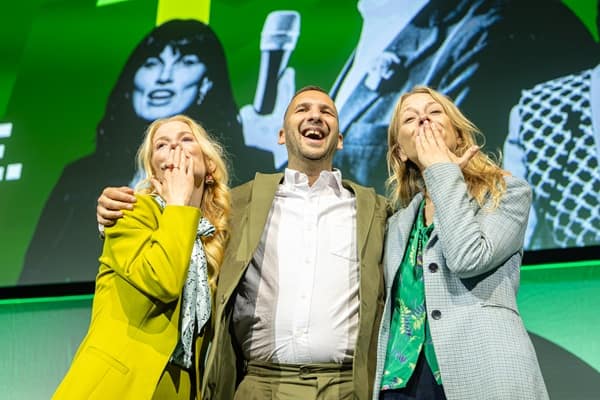
Zack Polanski’s Green Party has formally declared itself an anti-Zionist party after members voted to define Zionism as a form of racism, delivering a decisive shift in policy that has exposed deep divisions among its senior figures.
The motion, passed at the party’s 2026 conference in Brighton by 1,022 votes to 813, was adopted without substantive amendment. Three proposed amendments were rejected, despite attempts to alter the wording of the policy.
The decision places opposition to Zionism formally at the centre of the Greens’ political platform, alongside its existing support for Palestinian liberation, the right of return for Palestinians, the Boycott, Divestment and Sanctions movement and a full arms embargo on Israel.
The motion describes Zionism as an “ethnonationalist political project” and explicitly states that opposition to Zionism should not be equated with antisemitism.
It also calls for the creation of a single democratic state across historic Palestine, a position that would fundamentally alter the political framework surrounding the Israeli-Palestinian conflict.
The vote nevertheless exposed an uncomfortable question for the Greens: whether a party seeking to define itself as uncompromisingly anti-racist can adopt a policy that some of its own senior figures fear could alienate Jewish members and supporters.
Polanski did not participate in the vote. The Green leader had left the conference following his speech on Friday to campaign in the Holborn and St Pancras by-election.
The three substantive amendments were defeated by significant margins. The first fell by 920 votes to 821, the second by 948 to 798 and the third by 1,086 to 684. A fourth, primarily administrative amendment, was passed by a show of hands to bring existing party policy statements into line with the newly approved position.
The party sought to portray the result as a legitimate exercise of its internal democracy.
A Green Party spokesman said the debate had been “serious and deeply felt” and insisted that the party remained committed to opposing racism and supporting equality, justice and human rights.
“The Green Party is an anti-racist party and has consistently opposed the illegal occupation of both Palestinian and Syrian land, called for an end to arms sales to the Israeli government and spoken out fearlessly about the devastating situation in Gaza and the West Bank,” the spokesman said.
“Those positions remain central to our approach. So too does our deeply held commitment to equality, justice and human rights for all and opposition to racism in all its forms.”
But the policy has already prompted warnings from figures who helped build the modern Green Party.
Caroline Lucas, who became the Greens’ first MP in 2010, said she had “serious concerns about this motion”.
“There is no single definition of Zionism, and irrespective of the intentions of the people who put that motion forward, I think there is a real risk that it’ll be divisive and could be seen as a sign that Jewish people aren’t welcome in the party,” she told the BBC.
“I will not be supporting it for that reason.”
Adrian Ramsay, the party’s first male MP after winning Waveney Valley in 2024, also criticised the decision.
“The Green Party has a strong position already on challenging the government and I think it would just be wrong to adopt a policy that could be seen as not supporting the rights of both Israelis and Palestinians to statehood,” he told The Times.
“I stand by the position the Green Party had in the 2024 manifesto, on which I was elected which made clear we want to see equal rights for Israelis and Palestinians.”
The reaction among delegates reflected the intensity of the debate. One supporter told GB News: “Zionism is a colonial invention.”
Another said: “On a personal thing, I believe Zionism is racism.”
But a third delegate warned: “There is nuance, and I’m worried about the split it is going to produce.”
That split may now become the central political consequence of the vote.
The Greens have moved beyond opposing specific policies of the Israeli government and have formally embedded opposition to Zionism within their party framework.
For Polanski, the immediate challenge is to reconcile that position with his party’s insistence that it welcomes Jewish people and opposes antisemitism in all forms.
The Brighton vote has answered one question decisively: the Greens now have an explicitly anti-Zionist policy.
The harder question is whether the decision strengthens the party’s political identity — or leaves it facing a new and potentially damaging internal fault line.


Leave a Comment