
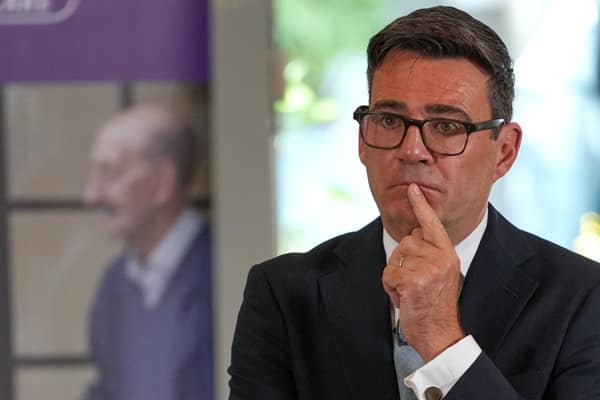
A former senior Russian diplomat has warned that British factories producing drones and other weapons for Ukraine could become targets of attacks by “unknown sources”, in an escalation of Kremlin rhetoric as tensions between London and Moscow deepen.
Andrei Fedorov, a former deputy foreign minister and Kremlin-linked commentator, refused to rule out “semi-military” action against Britain after Prime Minister Andy Burnham authorised the release of classified information on British components used in Ukraine’s long-range missiles.
Speaking to BBC Newsnight, Mr Fedorov said Russia could respond to Britain’s decision to help Ukraine manufacture French Scalp missiles, the French counterpart to the British-French Storm Shadow system.
“Sooner or later, there might be not only verbal but maybe some visible reaction from Russia towards the UK,” he said.
Pressed on what that response could entail, Mr Fedorov said: “There are different discussions how it should look like – it might be so-called technical reaction, maybe some hackers attack from unknown source, not from official level of course.
“There might be different political steps and I cannot exclude 100 per cent that there might be some semi-military, for example.”
Asked what he meant by “semi-military”, he pointed directly towards Britain’s defence industry.
“For example, something might happen with enterprises, with the factories which are producing drones for Ukraine, etc etc.”
And when asked whether Britain itself could face a direct Russian threat, Mr Fedorov smiled before replying: “They could be attacked, not by Russia, but by… unknown sources.”
The remarks come after Mr Burnham agreed to allow European defence company MBDA to declassify information concerning UK components used in the Scalp missile, enabling Ukraine to pursue domestic production of the long-range weapon.
Kyiv has used Storm Shadow and Scalp missiles against targets inside Russia, making the disclosure particularly sensitive in Moscow.
Dmitry Peskov, Vladimir Putin’s spokesman, accused Britain of pouring “fuel on the fire” by deepening its military support for Ukraine.
Mr Burnham offered a blunt response.
“Who started the fire? That’s the question, isn’t it?” he told reporters.
The exchange comes against a backdrop of increasingly hostile relations between London and Moscow, with Russia having withdrawn its ambassador Andrey Kelin and failed so far to nominate a successor.
The diplomatic downgrade has raised concerns over the loss of channels that could help contain an escalation between two nuclear-armed states.
Russian officials and state propagandists have also issued increasingly explicit threats against Britain, including suggestions that Moscow could deploy nuclear-capable Poseidon weapons.
At the same time, European security agencies have been investigating a series of suspected Russian cyber and sabotage operations targeting defence companies and infrastructure supporting Ukraine.
The Kremlin denies responsibility for such covert attacks.
Mr Burnham’s visit to Kyiv, his first foreign trip as Prime Minister, nevertheless underlined Britain’s increasingly central role in Europe’s support for Ukraine.
He met President Volodymyr Zelensky while co-chairing the 34-nation “coalition of the willing”, which has pledged military support for Kyiv.
The Prime Minister said the coalition was “doing everything we can” to “dig into our own stocks and help others dig into their stocks” of air defence systems.
“Ukraine has been Europe’s protector – not a drain on our security, but the front line in keeping Europe safe,” he said.
Mr Burnham also called on Washington to increase economic pressure on Moscow, arguing that Russia’s finances were being squeezed by a record budget deficit and falling oil revenues.
The appeal comes as Ukraine faces a shortage of Patriot interceptor missiles, with supplies diverted towards the conflict with Iran.
Kyiv has repeatedly pressed the US for additional systems as Russia intensifies its ballistic missile campaign. At least 23 people have reportedly been killed and more than 100 wounded in Russian strikes over the past three days.
For London, the threat is becoming harder to dismiss as rhetoric alone. The Kremlin’s message is that the battlefield may no longer stop at Ukraine’s borders — and Britain’s defence industry could be part of the next front.


Leave a Comment