
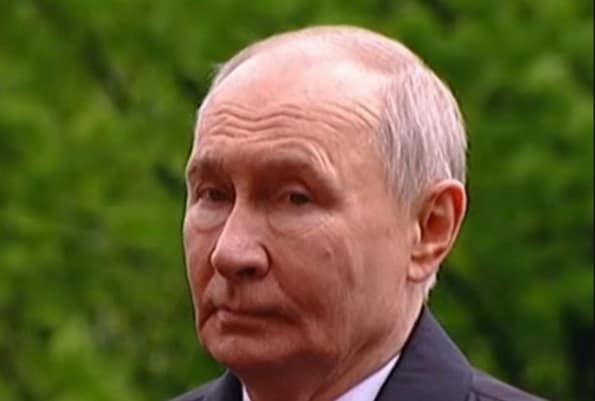
As the war in Ukraine grinds on, speculation has once again surged over whether Vladimir Putin could resort to nuclear weapons — either to force a breakthrough on the battlefield or, in the most extreme scenario, to threaten Europe directly.
It is a question that returns repeatedly in moments of military strain: could Russia’s leadership escalate to tactical nuclear use, or even contemplate a wider nuclear confrontation with NATO?
The short answer from most Western defence assessments is sobering but important — the risk exists in theory, but remains low-probability and heavily constrained by overwhelming consequences.
The nuclear threat that shadows the war
Since the invasion began, the Kremlin has repeatedly referenced Russia’s nuclear arsenal in statements designed to project deterrence.
These warnings have often intensified during periods of battlefield pressure, prompting concern in Western capitals that Moscow could seek to “escalate to de-escalate” — using shock tactics to force negotiations.
But intelligence assessments across NATO consistently highlight a crucial distinction between rhetoric and intent.
Nuclear signalling, analysts argue, is being used as a tool of psychological pressure — not a roadmap for imminent action.
Why a tactical nuclear strike would change everything
A tactical nuclear strike in Ukraine would represent a historic escalation — but not necessarily a decisive military one.
Military analysts point out that such a move would likely:
- Trigger catastrophic diplomatic isolation
- Risk direct NATO involvement
- Fail to deliver guaranteed battlefield control
- Destroy remaining strategic partnerships outside the West
- Cross a threshold that has held since 1945
In other words, while the weapon is “tactical” in name, its consequences would be anything but contained.
The Europe scenario: feared, but far less likely
Even more extreme is the idea of a pre-emptive nuclear strike against NATO territory.
This is widely regarded in defence circles as an extraordinary worst-case scenario, not a practical policy option.
Such an act would:
- Trigger immediate NATO collective defence obligations
- Invite overwhelming retaliatory response
- Likely lead to regime-ending escalation
- Break the foundational logic of nuclear deterrence
Put simply, it would be less a military strategy than a collapse of strategic logic itself.
Pressure, rhetoric and miscalculation risk
Where concern does persist is not in deliberate planning for nuclear war, but in the risk of miscalculation under pressure.
As the conflict drags on, analysts warn of scenarios involving:
- Escalatory signalling during battlefield setbacks
- Misread intelligence or command decisions
- Attempts at coercion that spiral beyond control
- Increased reliance on nuclear rhetoric as leverage
This is the grey zone where modern deterrence systems are most heavily tested.
The reality behind the fear
Russia retains one of the world’s largest nuclear arsenals, but any decision to deploy it would carry consequences so severe that it fundamentally shapes decision-making at the highest level.
That is why, despite periodic waves of alarm, Western governments continue to treat nuclear use as unlikely, but not impossible — and therefore constantly monitored.
A dangerous war, but still bounded by limits
The war in Ukraine has repeatedly defied expectations, escalating in intensity, technology and reach.
But on the nuclear question, the boundary has so far held.
For all the rhetoric, pressure and speculation, the consensus among defence analysts remains that nuclear escalation — particularly against NATO Europe — sits at the very edge of strategic reality, not its centre.
And in a conflict defined by uncertainty, that distinction matters more than ever.


Leave a Comment