
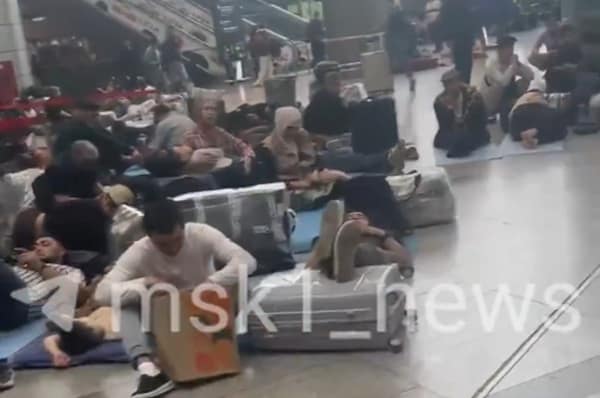
Russia is tightening its recruitment drive as security checks at airports reportedly expose newly naturalised citizens to conscription notices, adding to concerns that the Kremlin is expanding a largely covert mobilisation campaign to sustain its war in Ukraine.
The Russian organisation OTPOR, which provides legal assistance to people seeking to avoid mobilisation, said activists had documented cases at Koltsovo Airport in Yekaterinburg where men who had recently acquired Russian citizenship were served with military enlistment notices upon arrival.
Ukraine’s partisan movement Atesh shared the account, which described additional checks of military registration status at airports.
Russia’s Interior Ministry has separately confirmed 17 migration control points at airports across the country.
Reports that military enlistment officers are permanently stationed at every Russian airport have not been independently verified. But the accounts have revived memories of 2022, when a mobile military enlistment office was reportedly established at the Verkhny Lars border crossing with Georgia, where men attempting to leave Russia were served with conscription notices.
Read more related news:
Britain prepares troops for Ukraine deployment as Trump deepens rift with NATO allies
Army chief warns ‘war is no longer unthinkable’ and MPs will have to tell Brits ‘where the risk lies’
A breached fence, grounded Russian aircraft and Leipzig Airport under a cloud of suspicion
Britain’s warning of a silent war on an ‘ordinary Monday’ and ‘the attack you may never see’
“Now, additional checks are being conducted at airports as well. This is evidence of a new wave of mobilisation and another reason to closely monitor what is happening,” the report said.
The developments come as Ukraine’s Main Directorate of Intelligence, cited by Ukrainska Pravda, estimates that Russia could recruit as many as 600,000 additional military personnel in stages during 2026 and 2027, with 300,000 targeted in each year. The projection has not been independently confirmed.
Rather than risk the political consequences of another openly declared mobilisation, Moscow is increasingly relying on contract recruitment, financial inducements and pressure on people with fewer economic or legal options.
That strategy is showing signs of strain. According to the Ukrainian intelligence assessment, Russia recruited 71,216 service members in the first quarter of 2026, its lowest quarterly total in three years. Regional enlistment bonuses have risen by 25 per cent compared with 2025, reaching approximately $16,000-$18,500, while convicts signing military contracts can receive about $12,500.
Even higher payments may not be enough to maintain the flow of recruits. Ukrainian intelligence estimates that the available pool of indebted people, convicts and migrants has shrunk by 30-40 per cent.
A separate campaign to recruit university students into drone warfare units reportedly secured only a quarter of its target. Russian outlet DOXA reported that recruiters used university administrations to pressure students, particularly those with academic arrears or facing expulsion, despite promises of financial rewards and tuition-free education.
The recruitment effort is also extending beyond Russia’s borders. Moscow is seeking foreign nationals from former Soviet republics and countries across Asia, Africa, Latin America and the Middle East, according to the assessment.
At home, the system is becoming more automated. Electronic military registration and digital draft notices can facilitate recruitment without a formal public mobilisation announcement. Authorities are also considering expanded military police powers to pursue deserters and people suspected of evading service.
Regional intermediaries have become another part of the machinery. German economist Janis Kluge has cited Nizhny Tagil, where recruiters reportedly receive 400,000 roubles — about $4,500 — for each soldier they deliver. Allegations that some intermediaries have used violence to secure payments raise questions about the risks of outsourcing recruitment to local networks.
More serious allegations concern the use of criminal proceedings to pressure suspects into military service. Reports suggest some people may be offered a choice between prison and signing a military contract, with charges allegedly dropped in return. These claims have not been independently established.
Taken together, the accounts suggest a recruitment system under mounting pressure: bonuses are rising, student recruitment is falling short and authorities are widening the groups they seek to enlist. Airport checks alone do not prove that a new nationwide mobilisation has begun. But they point to the Kremlin’s continuing search for manpower — and to the growing importance of administrative pressure in a war that continues to consume soldiers.


Leave a Comment