
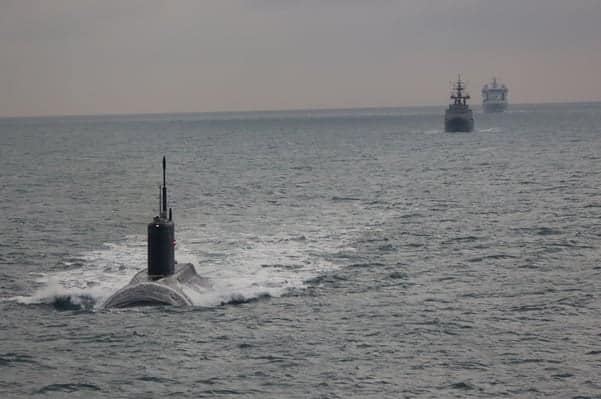
Russia is building a detailed picture of Britain’s undersea infrastructure and could seek to disrupt several cables simultaneously in a coordinated attack, according to Tobias Ellwood, the former UK defence minister, who warned that such an assault could rapidly become a national economic crisis.
Ellwood said Moscow was developing an understanding of critical subsea infrastructure not only around Britain but across northern and western Europe, raising concerns about the vulnerability of communications and energy networks in the North Sea, the Express reported.
Asked whether the threat extended beyond individual coastal communities, Ellwood said: “No, this is national. It depends on what you’re talking about—whether it’s data, oil, gas, or so forth—but essentially, they link in as a national asset.”
Britain’s subsea networks include dozens of major cables carrying internet traffic, financial data and other communications. The Submarine Cable Map identifies 63 main cable systems associated with the UK, with landing points ranging from Cornwall and Suffolk to North Wales, the north-east and the south coast.
Bude in Cornwall is connected to systems including 2Africa, Amitie, Apollo, Atlantic Crossing-1, Europe India Gateway, EXA North and South, FLAG Atlantic-1, Glo-1 and Grace Hopper.
Lowestoft in Suffolk is similarly linked to Circe North, EXA Express, EXA North and South, Farland North, Q&E North, Scylla, Tampnet South and Ulysses 2.
Ellwood said the activity was part of a wider Russian effort to understand the infrastructure underpinning European economies.
“Russia is developing a real program of understanding here—not just for British assets, but also across Scandinavia, Denmark, France, and beyond.
“They’re mapping where these are and assessing how easy they are to target for the future.”
The warning comes amid increasing concern among European governments over the vulnerability of subsea infrastructure, after a series of incidents involving damaged cables and pipelines in the Baltic and North Atlantic.
Ellwood pointed to the destruction of the Nord Stream pipelines as an example of the potential consequences of attacks on critical infrastructure. He argued that a deliberate assault would potentially involve multiple targets rather than a single cable.
“If there is going to be a major attack, Russia wouldn’t cut just one cable—it would be carried out across a number of them simultaneously.”
Britain’s communications network has some redundancy, allowing traffic to be diverted when individual cables are damaged. But Ellwood warned that simultaneously disabling several systems could place alternative routes under severe pressure.
“Banking and the City of London would be immediately affected,” he said, adding that operators would seek to redirect traffic through alternative routes.
“There is a fair bit of redundancy—meaning you can switch traffic to another cable—so there is a little bit of backup, but not a lot.”
The capacity to repair damaged infrastructure is another potential constraint. Ellwood said Britain had only a small number of commercial vessels capable of carrying out subsea cable repairs and argued that the requirement for naval protection could further limit the speed of any response.
“We only have three commercial ships capable of repairing undersea cables, and each requires a naval escort. If more than three cables are clipped at the same time, you get a complete backlog. Russia knows all this.”
The comments reflect a broader shift in European security thinking towards infrastructure that sits outside traditional military targets. Undersea cables and pipelines have become increasingly important strategic assets because they connect financial markets, businesses and households to global communications and energy networks.
Ellwood argued that Moscow’s objective would not necessarily be a conventional military confrontation with Britain.
“Russia is not going to invade Britain; modern warfare is all about this asymmetric disruption.”
He also argued that infrastructure disruption could have a political as well as economic effect, potentially weakening public support for Ukraine and creating divisions among western allies.
“This is all about their core objective: getting the British public to say, ‘Goodness me, it’s really not worth supporting Ukraine. Why are we doing this when it’s now bleeding across to us?’ That is what Russia is trying to achieve—breaking up NATO and getting us to argue amongst ourselves.”
The warning highlights the difficulty facing governments seeking to protect infrastructure that is privately owned, dispersed across international waters and essential to the functioning of modern economies. For Britain, the potential vulnerability of the seabed has become an increasingly important component of national security planning.


Leave a Comment