
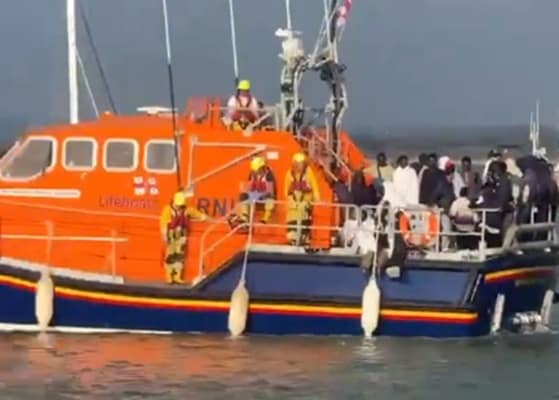
Port authorities in Southampton and Portsmouth refused requests to allow lifeboats carrying around 140 migrants to dock, forcing the vessels to divert to another landing point where hundreds of protesters later gathered.
RNLI crews had sought to bring those rescued from a record small-boat crossing ashore at Southampton and Portsmouth Harbour, according to accounts of the operation.
The vessels were ultimately directed to Eastney, several miles away, where the arrival prompted a large-scale protest and a difficult police operation.
The decision exposed the logistical pressures facing authorities as larger and increasingly unpredictable Channel crossings test the capacity of coastal infrastructure and emergency services.
A spokesman for Associated British Ports (ABP), which operates Southampton, confirmed that the organisation had been approached about receiving migrants rescued at sea but had declined the request.
They said: “ABP did receive an enquiry about landing recovered migrants at the Port of Southampton.
“We had to decline the enquiry as the port did not have suitable reception facilities available. If there had been a safety of life at sea issue where Southampton was the closest port or if we had received a formal direction from the authorities, then we would have played a role.
“Neither was the case in this situation.”
The migrants were eventually brought ashore at Eastney, where the limited road access complicated efforts to move them onwards to the Manston processing centre in Kent.
Hundreds of protesters gathered in Portsmouth late on Sunday, attempting to prevent three coaches carrying migrants from leaving the area. Some demonstrators subsequently pursued the vehicles as they travelled towards Dover.
The episode followed a record crossing attempt involving around 120 people who had departed from near Cherbourg, intensifying political pressure on the government over its approach to Channel migration.
Conservative leader Kemi Badenoch accused Labour of being “weak” on immigration, while the incident prompted warnings that other coastal locations, including Brighton, Southampton and Weymouth, could increasingly become landing points as people-smuggling networks seek alternative routes.
The disorder also placed significant pressure on Hampshire Police, with officers reporting assaults and damage to police vehicles during the operation.
Spencer Wragg, chair of Hampshire Police Federation, said one of the officers injured during the incident was “only three days out of training school”.
Mr Wragg said officers themselves appeared to have become targets as they attempted to manage the crowds.
He said: “We’ve received reports of officers being assaulted, I’ve seen footage of officers being pushed off their motorbike, I’ve seen pictures of police vehicles damaged. It appears that the police last night became the target for some of the protest.
“Thankfully there are no serious injuries to officers, but the professionalism they showed in the face of provocation and immense pressure was admirable. Those scenes in that area of Portsmouth weren’t protests, they weren’t protests at all, it was clear that some people were intent on disorder and venting their frustrations.
“If people have a point to make, and an issue they want to legitimately protest about, that is not about assaulting officers, that is not about damaging vehicles or anything like that. That is just disorder.
“One of policing’s key roles is to protect people’s right to protest, and having been a public order officer for 30 years myself, I’ve policed numerous protests. The vast majority of protests and people attending protest do so peacefully and want to get their view across.
“What we saw last night and into the early hours of this morning doesn’t support the cause of those peacefully protesting, it was merely criminal behaviour of assaults, damage and intimidation.”
The confrontation highlights the increasingly difficult operational challenge posed by Channel crossings, with the question of where rescued migrants should be brought ashore becoming a politically sensitive issue in its own right.
While the government has focused heavily on disrupting smuggling networks and strengthening border enforcement, Sunday night’s events demonstrated the potential consequences when large groups of migrants arrive unexpectedly at ports without dedicated reception facilities.
For police and local authorities, the prospect of further large-scale crossings landing at different points along Britain’s southern coastline could create a new layer of uncertainty. Ports designed primarily for commercial or recreational traffic may find themselves increasingly drawn into a politically charged border operation for which they have limited infrastructure or planning.
The disorder in Portsmouth is also likely to sharpen concerns about the policing of migration protests, particularly as public anger over Channel crossings continues to intersect with the practical difficulties of accommodating and transporting those arriving in Britain.


Leave a Comment