
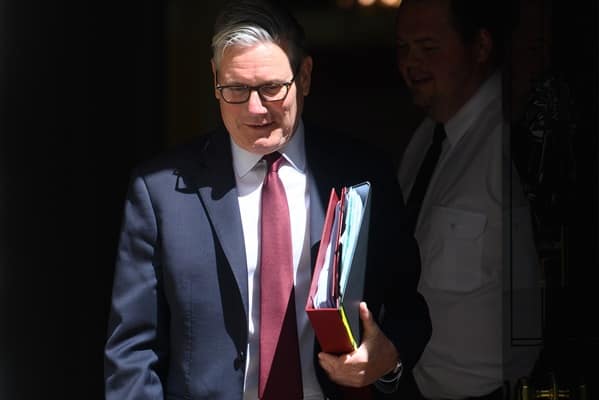
There are farewell tours and there are political autopsies.
Sir Keir Starmer arrived at Prime Minister’s Questions hoping to present the former. Instead, Kemi Badenoch delivered something much closer to the latter.
The Conservative leader’s most damaging line was also her simplest.
“If it’s all going so fine, why is he resigning?”
The question cut through the carefully constructed narrative that Starmer attempted to present to the Commons. In his account, Britain is recovering, public services are improving, NHS waiting lists are falling, workers’ rights have been strengthened and hundreds of thousands of children have been lifted from poverty.
Yet the Prime Minister is leaving office.
That contradiction now sits at the heart of Labour’s political crisis.
Successful prime ministers are rarely removed by their own party. Those who preside over economic recovery, electoral success and public confidence are not usually counting down the days until their departure from Downing Street.
Badenoch’s intervention was effective because it exposed the gulf between Labour’s public message and political reality.
The reality is that Starmer is not leaving because he wants to. He is leaving because Labour MPs concluded his leadership had become unsustainable.
The Conservative leader went further, arguing that the Prime Minister had been abandoned by the very people who once championed him.
“He has been let down,” she declared, before listing cabinet colleagues, ministers and backbenchers whom she accused of contributing to his downfall.
The imagery was deliberately theatrical. Her claim that Labour MPs had placed “400 knives” into Starmer’s back captured the sense of a governing party engaged in a public act of political self-destruction.
There was also a wider strategic purpose.
Rather than treating Andy Burnham’s emergence as a fresh start for Labour, Badenoch sought to portray it as merely a cosmetic change.
“What for?” she asked. “A pair of eyelashes and a black T-shirt.”
The line was mocking, but the argument beneath it was serious. Conservatives increasingly believe that Labour’s problems are structural rather than personal. Replacing the leader may change the presentation, but not the tensions between Labour’s competing factions, spending ambitions and economic constraints.
Whether that argument proves convincing remains to be seen.
For now, Burnham’s arrival has energised many Labour supporters who see him as a more authentic and politically agile figure than Starmer. But leadership transitions also create risk. Expectations rise rapidly. Internal disagreements that were previously directed at an outgoing leader soon become the responsibility of the incoming one.
Starmer attempted to defend his record by presenting a catalogue of achievements and insisting that Britain is moving in the right direction.
Yet his position illustrates a familiar truth of politics.
Ultimately, leaders are judged less by the speeches they deliver at the end than by the confidence their own colleagues retain in them.
On that measure, the verdict had already been delivered long before Badenoch rose to her feet.
The Prime Minister entered the Commons as the leader of the government. He left looking increasingly like the caretaker of an administration preparing for its next chapter.
For Badenoch, it was one of her most effective parliamentary performances. For Starmer, it served as a reminder that political legacies are rarely written by those who leave office, but by those who remain behind to explain why they had to go.


Leave a Comment