
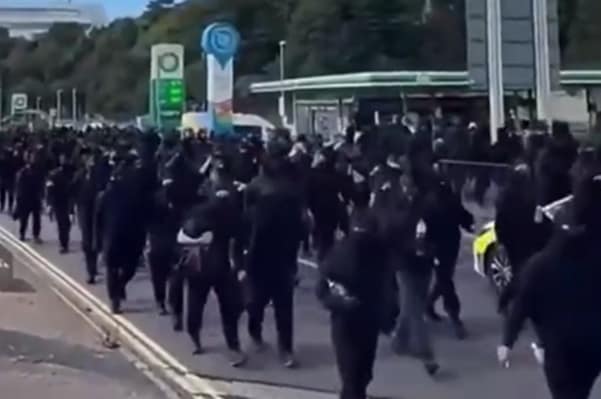
A former police superintendent has criticised what he described as an “intelligence failure” after an anti-migrant protest caused major disruption around the Port of Dover on Saturday.
Martin Gallagher, a terrorism and policing expert, said police should go “back to the drawing board” over how they gather intelligence on protest groups, after demonstrators blocked roads and caused traffic queues stretching for several miles.
The protest brought parts of Dover to a standstill, with demonstrators dressed predominantly in black and wearing black balaclavas. Protesters could be heard chanting “stop the boats” as they marched through the town.
Speaking to GB News, Mr Gallagher said police appeared to have missed opportunities to identify the scale and potential impact of the demonstration in advance.
“Unfortunately, it’s a failure here by the police. So whatever intelligence opportunities exist about this group, the anti-immigration group, they’ve obviously failed. So we’ve got that first to start.
“And they’re not appearing to be violent, I think we can see that, but they’re obviously making their feelings known.”
The former superintendent said police could also consider whether the demonstrators’ decision to dress in a similar manner had implications under public-order legislation.
Dover brought to a complete standstill as hundreds of Brits, sick of the invasion of our country, block the port 🇬🇧
pic.twitter.com/svKsOdVxMH— Tommy Robinson 🇬🇧 (@TRobinsonNewEra) September 5, 2026
He said: “One thing I think the police will be considering, though, given the numbers, given the way that they’re all dressed in the same manner is do they have to roll out the Public Order Act 1936, which is legislation that relates to a group forming in uniform that can be seen as acting counter to the state.
Now, I’m not sure of that ever being rolled out since the days of Sir Oswald Mosley, but it still exists, is still relevant legislation.
So yes, they can bring in a Section 60 to remove the face coverings and such and take matters on about blocking roads, but well, does this now count as uniform? Would it be construed as that?
“They’re all dressed the same, so it’s whether the police want to go down that route.”
Mr Gallagher was asked whether he was “surprised” that police appeared to have been caught off guard by the demonstration.
He said there had been “roundabout failures and intelligence gathering” involving political groups on both the left and right, pointing to another recent protest as evidence that the issue was not confined to one side of the political spectrum.
“I’m definitely surprised, but you could apply the same thing to the Just Stop Oil protest this week where there was a failure as well. So it’s maybe back to the drawing board for the police about these type of groups.
So on both sides of the political spectrum here, roundabout failures on intelligence gathering, because these are two examples this week where the police have been caught on the back foot.
Paul King, the Reform UK councillor for Dover West, said he had been told the demonstration was a “stop the boats protest”.
He wrote on Facebook: “Avoid the port area, large number of men have blocked the A20. I’ve been told it’s a stop the boats protest speaking to local women, they felt frightened by such a large group of men walking up the street.
“We don’t condone causing public disturbance by protest. But it’s a very good example of what is happening daily with the boats coming in.”
Kent Police confirmed that officers had been deployed to the protest.
In a statement on X, Kent Police said: “We are aware of a protest currently taking place at the Port of Dover. Officers are in attendance and engaging with protesters.”
The incident caused significant disruption at a key entry point to the UK, with roads leading to the port blocked and queues of traffic extending to four miles.
The government said it supported the right to peaceful protest but condemned the disruption caused by the demonstration.
A Government spokesman said: “The right to peaceful protest is fundamental to our democracy, but we condemn the behaviour in Dover and the travel disruption it has caused.
“We appreciate the frustration of those who have been impacted today. Access to the port is now restored and traffic is flowing. “
The events are likely to prompt further questions over how police forces anticipate large demonstrations, particularly where protests can rapidly affect critical transport infrastructure.
For Mr Gallagher, the central issue was not simply the conduct of protesters but whether intelligence about the group’s plans had been adequately gathered and acted upon before the demonstration took place.
His comparison with protests by groups on the opposite side of the political spectrum was intended to underline a wider challenge for policing: maintaining sufficient intelligence coverage across an increasingly fragmented protest landscape while ensuring that lawful demonstrations remain protected.


Leave a Comment