
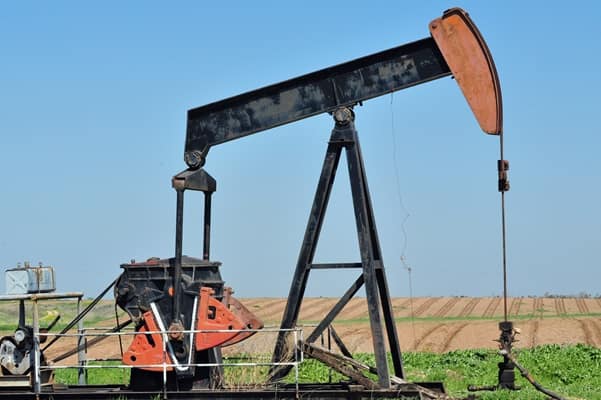
West Texas Intermediate Crude Futures fall by nearly 7 per cent, dropping below the $ 80 per barrel threshold, while Brent crude futures fall by nearly 6 percent, trading near $83 per barrel.
The drop in oil prices comes as the market clings to the main assumption stating that President Donald Trump cannot take escalation too far, after canceling a broad attack he had previously threatened.
In addition, the Organisation of the Petroleum Exporting Countries (OPEC+) announced it would raise its oil production in September for the sixth consecutive month.
This announcement by Trump showed openness from Iran to negotiate regarding the management of the Strait of Hormuz, according to what mediators told The Wall Street Journal. Trump also said talks are taking place today.
What happened over the weekend is a repeat of previous scenarios, when Trump would threaten massive escalation and then back down, calling for room for negotiation and saying that an agreement would be near.
However, the more these moves ostensibly aimed at de-escalation are repeated, the more they are followed by a return to mutual hostilities and renewed disruption to oil supplies flowing from the region, alongside targeting infrastructure for oil and gas production and export. This may also limit the effectiveness of OPEC’s oil production increase, given the essential reliance of Saudi Arabia, Kuwait, and Iraq on exports via tankers through the Strait of Hormuz.
These moves by Trump may indicate that he seeks to extract gains through diplomacy that war failed to achieve, or would not be able to achieve without a high political and economic cost, and that he is trying to buy time and force oil prices to drop significantly before pushing toward a massive escalation wave. In any case, whatever the goal of these maneuvers, Iran will see in this that the United States has lost deterrence, which is a growing narrative, and this will make it more aggressive, militarily or diplomatically, at the negotiation table, preventing it from rushing to make any concessions, whether regarding the management of the Strait of Hormuz, its frozen assets, or even its nuclear program.
The absence of signs of major concessions from Iran on outstanding issues, and the absence of a military resolution, do not give Trump any opportunity to declare victory and exit this war before the crucial midterm elections, whether for himself or for his Republican Party.
Not only that, let us return to where all this madness in the Middle East began: Gaza. Last Thursday, Trump announced that Hamas agreed to a plan to disarm, conditioned on Israel withdrawing from the Strip, where it controls more than 70 percent of the area.
Although I already believe that this agreement will remain on paper, this announcement was met with widespread criticism from right-wing Israeli political factions calling against withdrawal and for completing a military resolution.
The core issue here is that Israeli Prime Minister Benjamin Netanyahu is facing crucial elections in less than three months and has been unable to achieve any victory according to various views of domestic political factions, whether in Gaza or Lebanon, let alone Iran, which still retains a massive amount of its missile capabilities and nuclear program.
Therefore, I believe Netanyahu will accelerate the push toward reactivating broad military action against Iran, in an effort to secure an image of victory ahead of the elections in late October.
Furthermore, the massive US military buildup in the region, reaching nearly 50,000 troops, aircraft carriers, and fleets of fighter jets and refueling aircraft, does not align with the narrative of preferring the diplomatic path.
Thus, the risks of a return to escalation remain extremely high, in my view. This is bound to keep upside prospects for oil prices in place, unless we witness a comprehensive and deep agreement involving a high level of understanding between the parties of the war. There is nothing to suggest that so far. What we could witness over the coming days and weeks is either an unprecedented escalation or the continuation of the gray state currently prevailing, represented by a state of no peace and no war. However, remaining in this gray zone carries high risks of a return to full-scale regional war, given the continuous renewal of hostilities.


Leave a Comment